
How much weight a piece puts on the wall decides this list faster than style does, and a light Wood Wall Plaque and a Wood Wall Mirror sit at opposite ends of that scale.
A tall Wood Floral Relief, a large Woven Wood Wall Art piece or a full-length Wood Wall Mirror can lean on the floor or a shelf, while Wood Wall Shelves that hold real weight have to go into studs or proper anchors.
The materials run from reclaimed boards that cost close to nothing to Carved Wood Panels and Wood and Resin Art, and Pallet Wood Art, often still stamped EPAL or EUR, shows how far a free material can carry a wall.
1. Carved Wood Panels
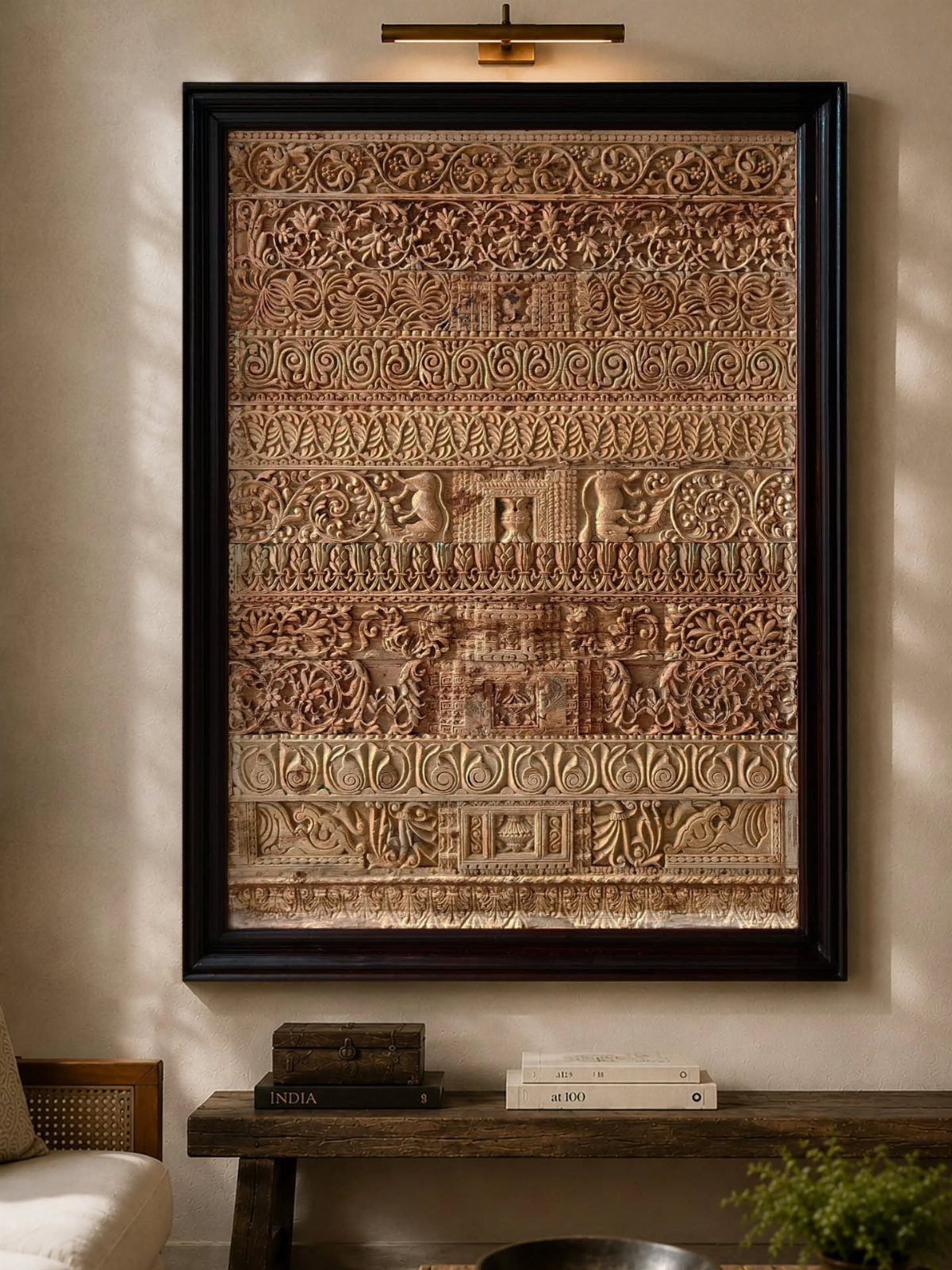
Deep relief is what makes a carved panel read as art instead of a flat print.
Shadows fall into the cuts and shift through the day, so the piece looks different at noon than it does under a lamp at night.
A black frame gives carved wood a hard edge and keeps the detail from drifting into the wall.
Hang it above a console or low dresser, where the surface below grounds it and gives you room to lean books or a small box nearby.
2. Geometric Wood Mosaics

Mixing wood tones does the heavy lifting in a geometric mosaic. Pale pine strips beside darker oak read as pattern from across the room, and you need no paint to get contrast.
The maker of this piece worked from a 5 ft length of oak plus a few cuts of pine, which tells me a small stack of scrap goes a long way.
Cut every strip on the same miter angle, dry-fit the full pattern on a table, then glue. A black frame hides ragged outer edges.
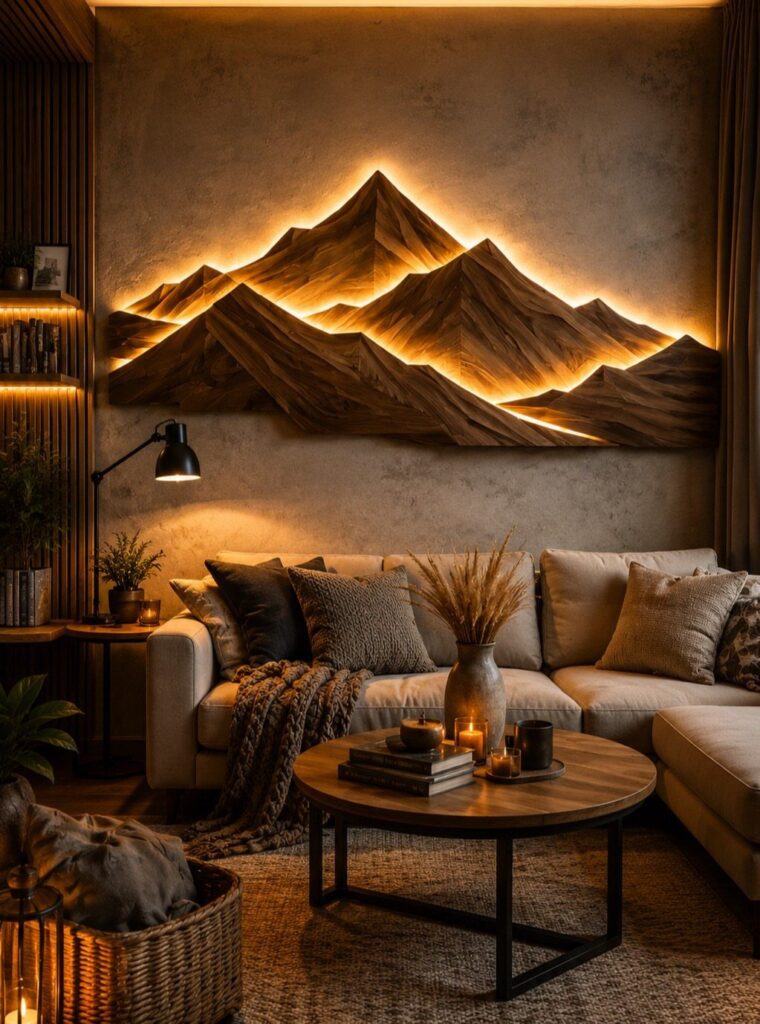
3. Mountain Wood Art

Stacking strips in layers, each one a little taller or shorter than the last, gives a mountain range real depth.
White-tipped peaks catch the eye first, so I’d save your lightest paint for those and leave the lower ridges in natural wood.
A deep wooden frame holds the layers and lets shadows build between them. A blue background behind the strips works like sky, and the piece looks right on a shelf or propped against a wall as easily as hung.
4. Reclaimed Wood Wall Art

Leftover boards earn a second life here, and the mismatched widths and grain are the whole appeal.
Layer the planks as a base, then add one bold graphic on top. A black wolf silhouette howling under a green aurora sky is a strong example: simple shape, high contrast, and the weathered wood keeps it from feeling slick.
Sand any rough edges before mounting, and use scrap you already have so the project costs close to nothing. Pick one focal image instead of several.
5. Wood Wall Shelves

Keep them small and the rustic texture stays charming instead of bulky.
I like that the shelf is the decor, so you skip the extra art.
Pair two at different heights for a relaxed, uneven look. Wood cups and dishes tie in with the bark, though I’d keep the load light and mount into studs or proper anchors.
6. Circular Wood Wall Art

A cluster of round panels breaks up a wall full of rectangles, and that is the reason I reach for them.
Vertical slats in natural wood, gold, and black give each disc its own rhythm while the shared circle shape holds the group together.
Mix sizes instead of repeating one.
Lay the pieces on the floor first, shuffle until the gaps look even, and trace paper templates onto the wall before you drive a single nail. A light wall lets the dark slats stand out.
7. Wood Wall Sculptures

A sculptural wall piece makes the wall itself feel deeper.
Mixed textures and brown tones in one frame give you a focal point that a flat print can’t match, and the frame keeps all those shapes reading as a single object.
Give it a big, empty wall with nothing competing nearby. Give a piece this size generous empty space on every side so it can breathe.
8. Wood Wall Art Sets
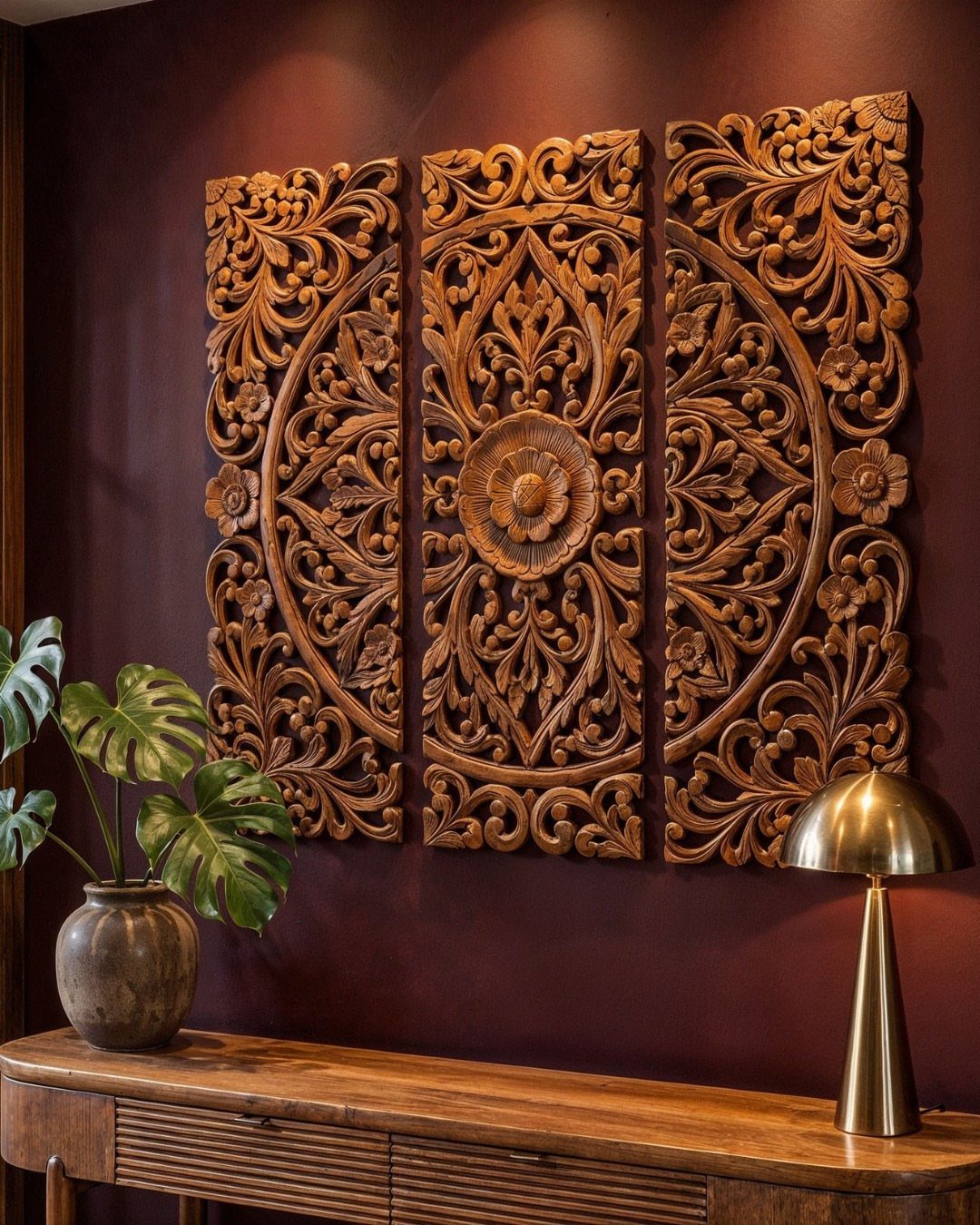
Three matching carved panels read as one statement, and floral patterns tie them together without any of them needing to be identical.
A dark red wall suits the warm wood, and a console below gives the group a base to sit over.
Keep the gaps between panels narrow and even, and center the row on the console. Cut paper templates and tape them up first, so you can judge spacing before any hardware goes in.
9. Wood Wall Art

Sage green is a softer way into wood art than raw grain. A carved abstract relief painted in one soft tone over a white wall reads as calm, and the depth of the carving still catches light.
Over a sideboard, keep the surface styling low: a lamp, a vase, a few books. The wall piece should be the tallest element in the grouping, so don’t stack more objects beneath it.
10. Wood Wall Cross

A plain wooden cross becomes a seasonal piece once you dress it.
Attach each stem with twine wrapped tight so nothing slips. Dried flowers are fragile, so hang it where doors and passing shoulders won’t knock it.
11. Wood Wall Mirror

A rounded wooden frame softens a full-length mirror, and leaning it means no wall damage at all, which suits renters. Beside a wooden nightstand, the frame echoes the furniture and the two look planned together.
Pick a frame tone close to the nightstand so the wood doesn’t clash. A grey wall lets the warm grain stand out.
12. Wood Wall Clock
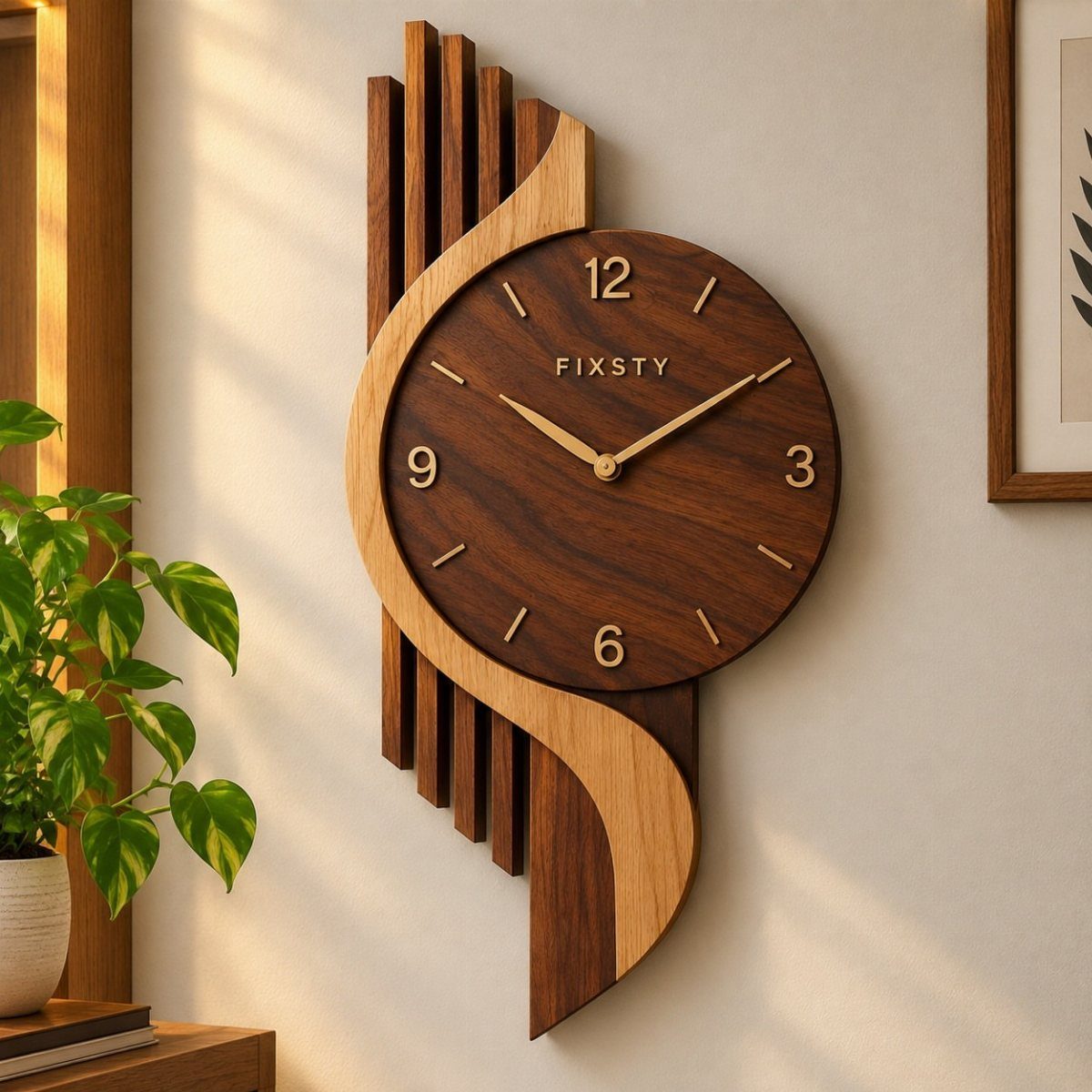
Numbers and hands in gold against a slatted wooden backing make a clock that works as decor first and timekeeper second. The slats add texture behind the face, so it holds its own even on a light wall.
Hang it near a plant or a framed picture so it joins a small grouping instead of floating alone. I’d choose gold hands over black here; they pick up the warmth of the wood.
13. Wood Wall Plaques

Painted or decoupage designs are what turn a plain wooden plaque into something personal.
Short phrases suit the format because a plaque has little room, and a column of them hung close together reads as one tall piece against a white wall.
Twine is the easy way to hang them, and varying the length of each drop keeps the column from looking stiff. I’d keep the lettering to one or two styles so the quotes don’t compete.
14. Figure Wall Decor

Hollow-centered wood squares turn small figures into a tidy gallery, and a grid with equal spacing keeps the whole thing orderly.
Each square frames its figure like a tiny stage, so the figures read clearly against a white wall without any extra color.
Hang the grid above a plant or a low surface, as here, so the greenery softens all those straight edges. Keep the spacing between squares equal, since a grid shows every uneven gap.
15. Woven Wood Wall Art

Interlocking planks give woven wood a dimensional pattern that a flat panel can’t copy; the over-and-under rhythm makes light and shadow do the decorating.
Light-colored wood keeps it airy, and leaning a large piece on the floor means no drilling, which suits renters.
Set it behind a rug or a pillow, as here, so the soft textures play against the hard weave. A piece this size needs a clear stretch of wall beside it.
16. Wood Slice Wall Art

Natural wood cross-sections clustered on a wall make art from one of the cheapest materials you can find.
Gluing them straight to the wall with a glue gun works, though I’d lay the whole arrangement on a table first and shuffle until the sizes balance.
Mix big and small slices, and let the bark edges and ring patterns vary. Keep the gaps tight and uneven rather than gridded, which is what makes a cluster feel organic.
17. Wood Slat Wall Art

Vertical slats turn a wall into a clean, rhythmic pattern, and the same wood can carry a whole corner.
I like repeating the slat look in one lower piece, because it makes the wall read as planned. Hang a large painting over the slats only if the pattern stays quiet.
18. Wood and Resin Art

Blue epoxy resin set between weathered planks makes a stripe that looks like water running through wood. Geometric, river, or linear layouts all work, and a straight stripe suits a mounted instrument best.
Match the wall to the resin: blue on blue, as here, makes the whole display feel unified. Keep each guitar’s body color distinct from the stripe, or the instrument disappears into the background.
19. Wood Leaf Panels
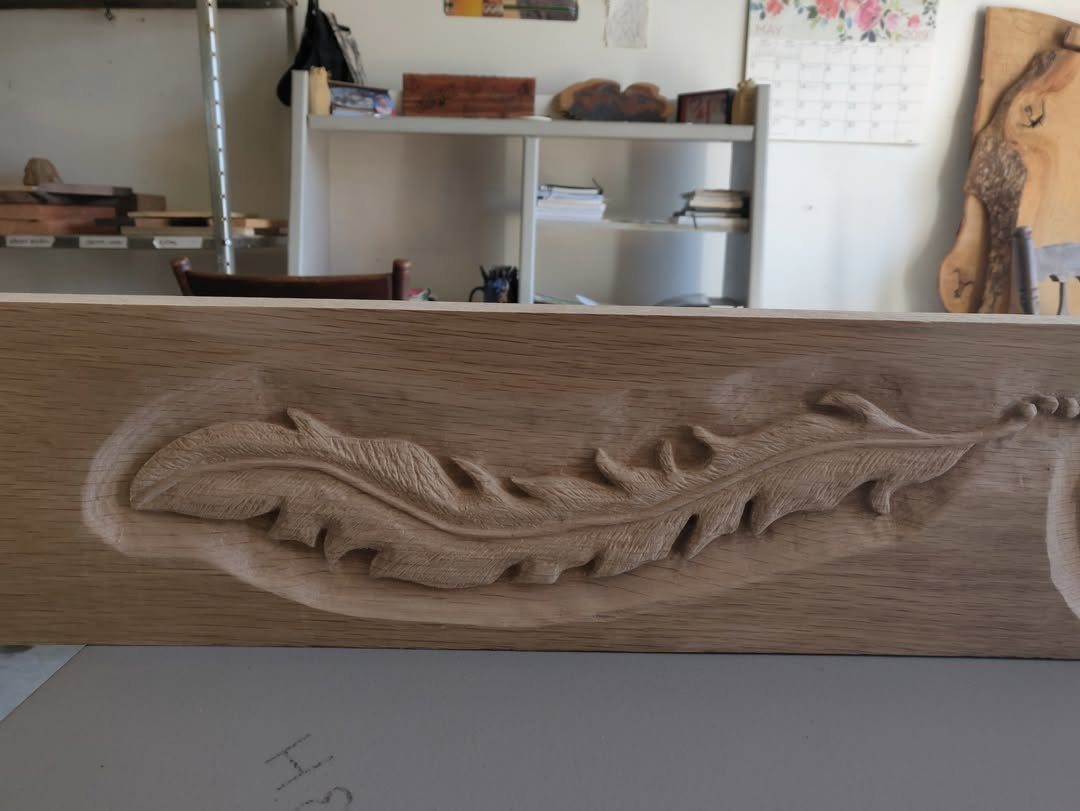
A recessed leaf pattern cut into light wood gives you botanical art without a single painted stroke. The carved lines hold shadow, so the veins and edges stay readable on a pale panel.
Keep the wood unstained if you can.
A clear finish lets the grain and the cut lines share the work, and a darker stain would flatten the detail. One panel on a quiet wall is enough.
20. Wood Sunburst Art

Radiating slats in mixed tones are the whole appeal of a wood sunburst, and the contrast between lighter and darker strips is what makes the rays read from across the room.
A reddish-brown wall suits the warm woods, though I’d go lighter on the wall if you want the dark rays to pop.
Cut every slat from the same stock width and fan them from one center point. Dry-fit the full circle on the floor before you glue anything.
21. Pallet Wood Art

Pallet planks already come with character, and the stamped marks, like the EPAL and EUR here, are worth keeping visible.
A wall-mounted rack built from them gives you storage and decor in one piece, which beats hanging a separate print above it.
Sand the boards well before assembly, since pallet wood splinters.
Check that the rack is fixed into studs or proper anchors, because bottles add real weight. A white wall keeps the rustic wood from feeling heavy.
22. Wood Sun and Moon Art

Black backgrounds make pale wood cutouts of a sun and a crescent moon with stars look sharp, and a matched pair in square frames reads as one idea split in two.
Hang them side by side at the same height with an even gap.
Cutouts in light wood against black give you the contrast with no paint on the shapes themselves. On a plank wall like this one, the dark squares keep the busy grain from swallowing the pieces.
23. Wood Bird Wall Art

Three carved birds mid-flight make a better focal point than one, because the group implies movement across the wall.
Stagger them at different heights and angles so they seem to travel, instead of lining them up like a row of tiles.
Over a sofa, keep the flock narrower than the sofa itself so it sits comfortably above. A plain white wall lets the carved wings show their shape, and I’d skip any other art nearby.
24. Wood Ring Wall Art

Rings in different sizes, grouped tightly, turn plain wood into a sculpture with open centers. The gaps let the wall show through, so the cluster feels lighter than a solid panel of the same size.
Lay the rings on the floor first and shuffle until the big ones anchor the group and the small ones fill the edges.
Let a few overlap. Above a sofa, a white wall keeps the natural tones in front.
25. Wood-and-branch Art
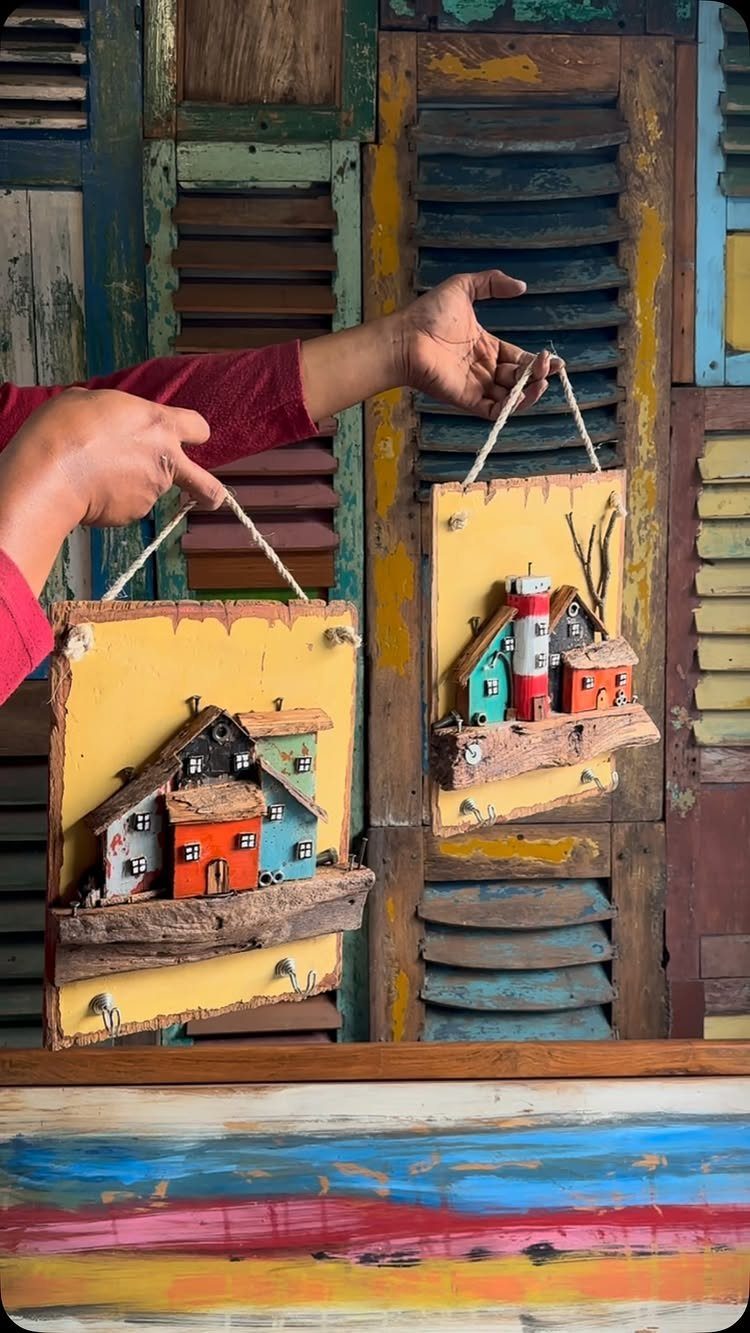
Wood slices set on branch bases turn tiny houses into a row of little frames, and a hand-painted door in a different color on each one keeps the group cheerful.
Keep the branches thick enough to stand or lean without wobbling.
Group the houses along a shelf or ledge so they read as one village. Keep the palette restrained, since the natural wood already adds plenty of variety on its own.
26. Wood Religious Reliefs

A carved Holy Family relief gets its quiet weight from the dark background, which pushes the lighter carved figures forward. 2 candles on either side turn the piece into a small devotional corner.
Give it a wall of its own with a shelf beneath for the candles.
I’d choose flameless candles if the relief hangs close, since an open flame next to carved wood is a risk. Keep the surrounding decor minimal.
27. Wood Floral Reliefs

Deep carving is what gives a wood floral relief its texture, so a single bloom can hold a wall without help.
Because it is tall and narrow, it fits a slim stretch of wall or a shelf where it can lean, which means no drilling for renters.
Pair it with small, low objects, like a clock and a white candle, so the carving stays the tallest thing in the grouping. I’d leave the finish natural; the carved grooves hold the shadows.
28. Wood Animal Reliefs

A black alligator carved into a polished reddish-brown plank gives you strong contrast: the dark shape sits right inside the warm grain. It works best as a single statement piece, not part of a gallery.
Choose a plank with a smooth, glossy finish so the carving stands out against it. Hang it low and horizontal, over a bench or console, where the long shape has room to stretch.