Yes, you can put a treadmill on carpet, but you’ll regret it without proper protection. That plush carpet will develop permanent divots faster than you can say “security deposit,” and carpet fibers will invade your motor like tiny saboteurs. A dense rubber mat is essential. It distributes weight, kills vibrations, and stops dust from choking your machine. Match mat thickness to your carpet pile: quarter-inch for low-pile, half-inch for plush. Vacuum underneath weekly or prepare for a dusty, wobbly nightmare. The setup details most people miss will determine whether your treadmill remains stable and protected.
Can You Put a Treadmill on Carpet?
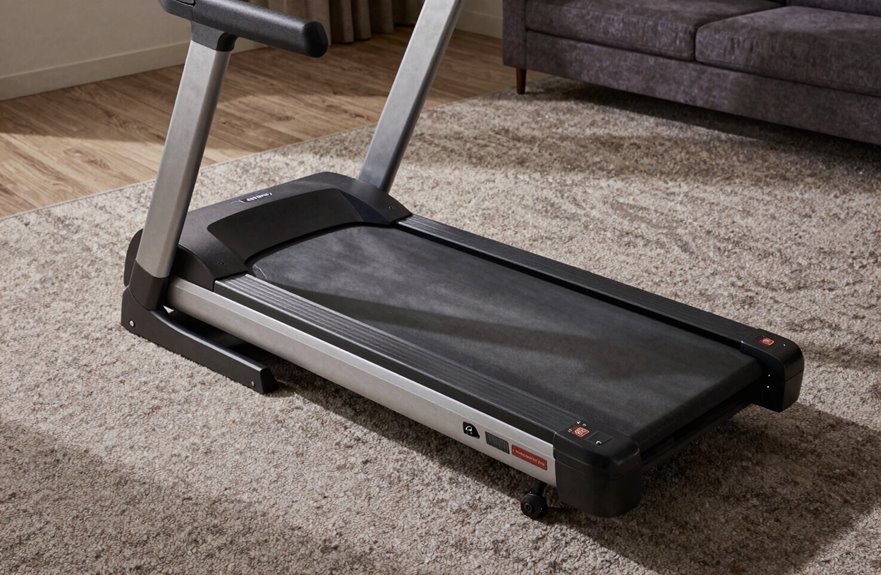
Yes, you can put a treadmill on carpet. I’ve made every mistake possible so you don’t have to. I’ve wrestled with this exact dilemma in my own living room, staring down at that plush beige Berber I inherited from the previous tenant, wondering if my new NordicTrack would chew it up like a hungry dog with a slipper.
Here’s what I’ve learned: grab a treadmill mat immediately. I skipped this once, and my carpet developed permanent dents that looked like crop circles. That mat isn’t optional carpet protection; it’s your insurance policy. Cover the full footprint, especially with heavier models. Vacuum underneath regularly (I do Sundays with my Dyson) and you’ll keep dust from invading your motor. We’ve all inherited questionable flooring decisions, but this fix actually works.
How Does Carpet Type Affect Your Setup?
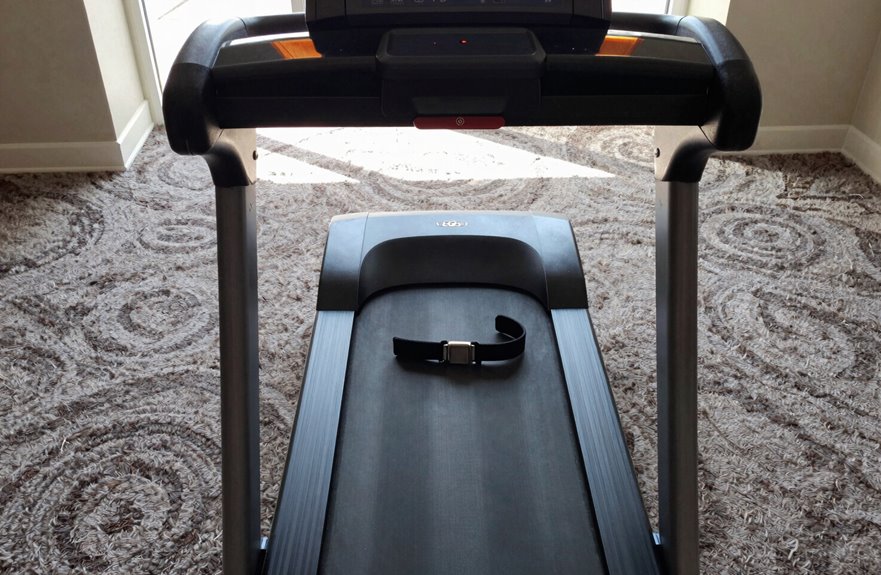
Your carpet type shapes everything about your treadmill experience.
- Low-pile carpets feel stable underfoot, and lighter treadmills sometimes skip the mat entirely, though the risk of damage remains.
- High-pile carpet creates problems. Those plush fibers wobble your deck, snag your incline, and collect dust.
- That trapped debris sneaks into belts and gears, which damages machine motors. This is why protection matters.
- A quality treadmill mat prevents permanent divots in your carpet and stops fiber infiltration into your machine, especially on uneven, fluffy surfaces.
A mat is a necessary upgrade for your setup.
Why Do Heavy Treadmills Damage Carpet?
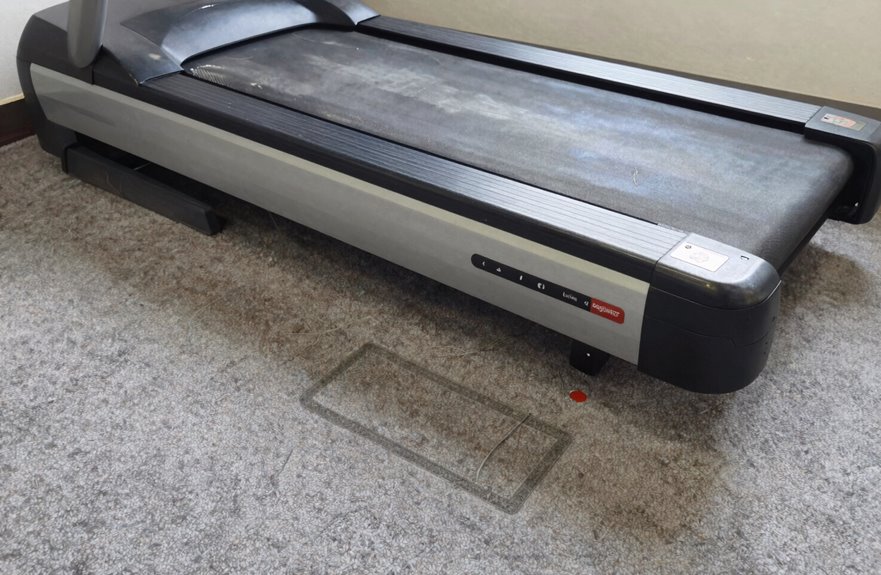
I’ve seen this happen firsthand, and it’s heartbreaking. My friend’s gorgeous Karastan wool carpet, the one she’d bragged about for years, ended up with deep, permanent dents where her NordicTrack sat, as if the fibers had simply given up under all that concentrated weight pressure.
Heavy treadmills don’t distribute their load evenly. They rest on tiny rubber feet that act like stiletto heels, crushing down thousands of carpet fibers per square inch until they’re flattened beyond recovery. Once that fiber compression damage sets in, you’re looking at a ruined patch that even professional steam cleaning can’t revive. Professional carpet cleaning services cannot restore this type of damage.
Concentrated Weight Pressure
How exactly does a single machine turn your plush carpet into a flattened memory of itself. Concentrated weight pressure is the silent culprit here.
Here’s what I’ve discovered about this sneaky damage:
- Those tiny feet, massive destruction. Your treadmill’s weight concentrates on four small contact points, crushing carpet padding like a stiletto heel on birthday cake.
- Friction nightmares. When I scooted my NordicTrack, the dragging action roughened my Berber’s backing permanently.
- Alignment chaos. My carpet’s uneven compression threw off my belt tracking; suddenly my “flat” road felt like San Francisco hills.
- The triple threat. Without a treadmill mat, you’re inviting heat, dust, and debris into your motor. I learned this after a $200 repair bill.
Carpet damage sneaks up fast.
Fiber Compression Damage
The vibrations loosened the backing, fibers shifted like a bad game of Tetris, and suddenly my “plush” looked like a topographical map. Dust and carpet fibers got sucked into the belt mechanism, causing double damage.
| What Happens | Why It Hurts |
|---|---|
| Feet crush cushioning | Permanent dents form |
| Vibrations loosen backing | Accelerated carpet wear |
| Dust enters treadmill | Belt damage + fiber breakdown |
A treadmill mat prevents this damage by distributing weight across the carpet surface, protecting both the machine and carpet from permanent indentation and wear.
How Does Dust From Carpet Harm Your Treadmill?
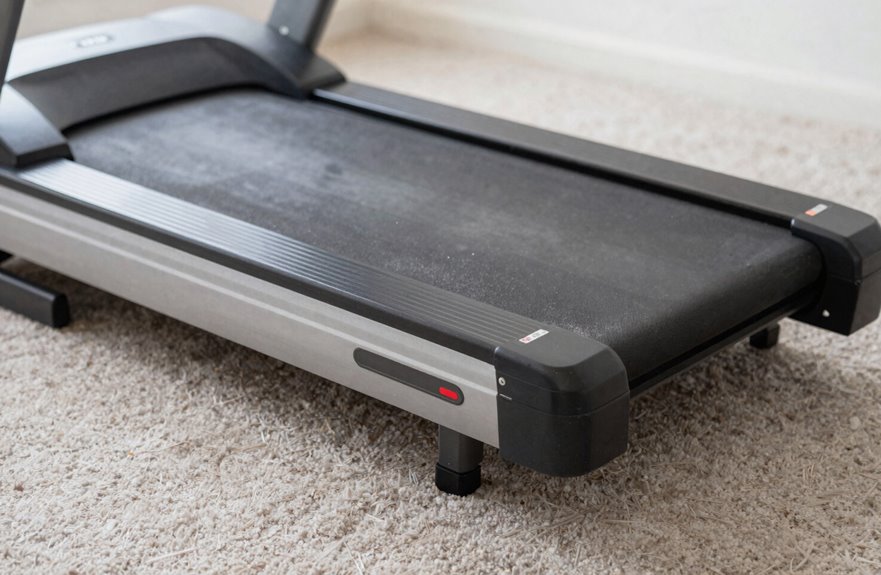
Carpet dust isn’t just an eyesore; it’s a treadmill killer. That fine grit and loose fibers get sucked right into the belt, gears, and motor, accelerating wear and risking overheating during intense exercise. Higher-pile carpets like plush Shaw Floors Anso styles are especially problematic, shedding fibers that clog rollers and contaminate cooling intakes. A good protective mat and regular vacuuming underneath can prevent costly repairs.
Dust Accumulation Risks
Why does my treadmill sound like it’s gasping for air after six months on carpet? I’ve been staring at my wheezing machine wondering what went wrong.
That carpet beneath your feet is a dust factory, and your treadmill’s basically vacuuming it up. Here’s what accumulates:
- Dust invades everything — belt, gears, motor housing — accelerating wear like sandpaper on silk.
- Vents clog up fast, suffocating cooling systems; suddenly your motor’s working overtime and overheating.
- Those abrasive particles grind away at belt surfaces and bearings (my first belt failed at month eight).
- Deck dust jams incline mechanisms, making rollers stutter and function poorly.
Vacuum underneath weekly. This prevents premature motor failure, extends belt lifespan by months, and keeps cooling systems functioning properly.
Component Damage Potential
Dust actively damages your treadmill’s internal components. Carpet dust and fibers work their way under the belt, into gears, and straight to the motor. These abrasive particles score belt surfaces, similar to sandpaper on silk, which increases friction and reduces lifespan. Loose fibers clog cooling vents, restricting airflow until your motor overheats. Incline mechanisms accumulate debris, lubrication becomes compromised, and movement becomes jerky and strained. The motor hood collects fiber buildup. Belt slippage occurs, bearings wear prematurely, and you end up purchasing replacement parts instead of maintaining consistent workouts. Regular cleaning prevents these costly failures.
Maintenance Prevention Strategies
Every time you wheel your treadmill onto carpet, you’re inviting a tiny fiber invasion into your machine’s internal components. After my first treadmill started sounding like a coffee grinder with anger issues, I learned this lesson firsthand. Your carpet isn’t just sitting there looking pretty; it’s constantly shedding microscopic particles that behave like glitter at a craft party.
I’ve discovered four strategies that keep my machine running smoothly:
- Vacuum underneath weekly. Dust bunnies multiply faster than excuses to skip leg day.
- Wipe the belt edges monthly where fibers love to hide.
- Check motor vents quarterly for buildup that chokes cooling.
- Use a mat underneath. It’s like a force field against rogue carpet debris.
Your treadmill will operate smoothly for years of reliable use when you follow these maintenance steps.
What Does a Treadmill Mat Protect?
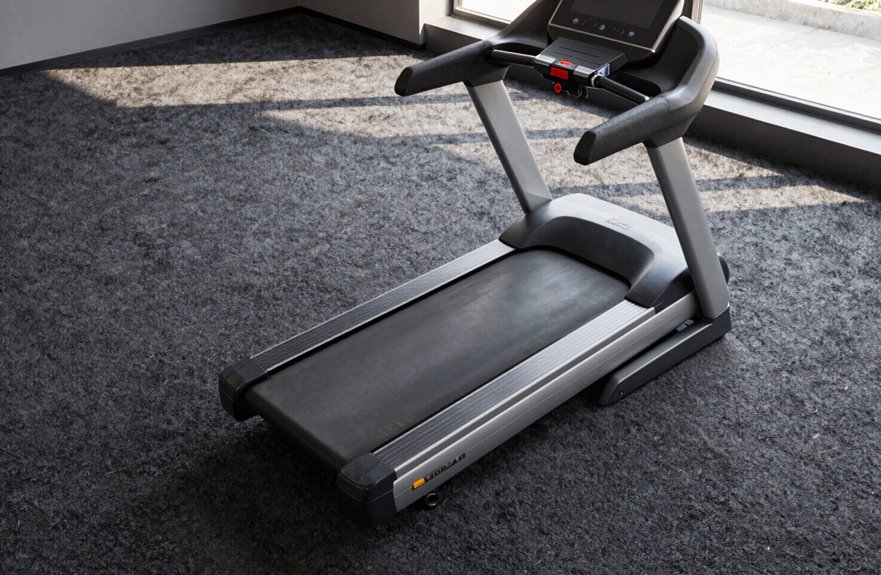
How exactly does a flimsy piece of rubber save your whole setup from disaster? A treadmill mat delivers serious protection for both your machine and your carpet.
I place my mat down and suddenly I’m not grinding metal into plush fibers or watching my machine wobble like a drunk giraffe. That rubber barrier stops scratches, scuffs, and tears I’d otherwise explain to my landlord with desperate hand gestures.
Dust and carpet fibers love sneaking into belts and gears, slowly killing your treadmill from the inside. The mat blocks that junk, extending your machine’s life significantly. I’ve seen repair bills that justify this simple investment.
The stable surface keeps everything level. Your incline mechanism works properly, no weird tilts mid-sprint. I’ve tested this on thick shag and low-pile alike. The difference is substantial.
Materials matter too. Rubber, EVA foam, PVC, and repurposed stall mats from Tractor Supply all work. Size it to your treadmill’s footprint, no skimping on coverage.
This isn’t overthinking. It’s a practical step that protects your flooring, your equipment, and your security deposit.
How Do Treadmill Mats Reduce Noise and Vibration?
That rubber barrier does more than save your carpet from damage. It reduces treadmill noise significantly.
That rubber barrier does more than save your carpet—it cuts treadmill noise dramatically.
Here’s how your mat tackles vibration and noise:
- It absorbs oscillations. The compliant layer between machine and floor dampens every belt stride so your downstairs neighbors won’t be disturbed.
- It muffles motor rumble. Rubber, EVA foam, or PVC construction cushions impact noise for peaceful living spaces.
- It locks down your footprint. Full-coverage sizing prevents edge shifting that amplifies annoying rumbles.
- It quiets carpet and hard floors. The ambient noise reduction is significant, whether you’re on shag or hardwood.
You’ll actually hear your playlist again.
How Thick Should Your Treadmill Mat Be?
I get asked about mat thickness all the time. A flimsy yoga mat won’t work when your treadmill starts inching across the room. For most of us with standard low-pile carpet, you’ll want something in that sweet spot of 1/4 to 1/2 inch thick. Think the rubber stall mats you see at Tractor Supply, not the cushy puzzle pieces from your kid’s playroom. If you’re dealing with plush, high-pile carpet, such as the shag variety, bump up to the thicker end and make sure it covers every inch of your machine’s footprint. Without proper coverage, your $2,000 NordicTrack can grind divots into the carpet.
Mat Thickness Basics
The sweet spot for a treadmill mat is thicker than you’d think, at least 3/8 inch, though half an inch provides superior protection. A wobbling setup on plush carpet creates instability during workouts.
Here’s what works for solid carpet protection:
- Go heavy-duty or go home – A stall mat (yes, horse stall mat) stops machines from creeping across the room.
- Match your treadmill’s footprint exactly – Undersized mats cause curled edges and tripping hazards mid-sprint.
- Pick PVC, rubber, or EVA foam – These materials are water-resistant, wipeable, and keep your carpet pristine underneath.
- Prioritize vibration dampening – Reduced noise and vibration transfer to floors below creates a more pleasant living environment for neighbors.
Carpet Pile Considerations
Mat thickness isn’t the whole story; your carpet’s personality matters just as much. Carpet pile completely changes what you need. Low-pile carpets are easy to work with. You can use a thinner treadmill mat without issues. Plush, high-pile carpet presents challenges. It shifts, it traps dust like a fiber flytrap, and suddenly your treadmill’s breathing in debris. Very thin mats sink into those plush fibers like quicksand. A resilient treadmill mat with real thickness works best. Choose one that distributes weight evenly and dampens vibrations. Your carpet pile determines your mat requirements.
Heavy Equipment Needs
Because I’m the kind of person who once bought a “heavy-duty” mat that turned out to be glorified yoga padding, I’ve learned this the hard way: your treadmill’s weight absolutely dictates your mat’s thickness. My poor living room carpet still hasn’t forgiven me. If you’re rocking a standard home treadmill, say something in the 200-pound range like a NordicTrack Commercial 1750, you’re looking at 1/4 inch minimum.
- Go 1/2 inch for equipment over 300 pounds. Stall mats from Tractor Supply work well with commercial-grade machines like the Sole F85.
- High pile carpet demands extra thickness or you’ll sink during sprint intervals.
- Thicker treadmill mats reduce vibration. My downstairs neighbor actually smiled at me last week.
- Always match mat specs to your machine’s weight rating. My first mat compressed into a pancake because I didn’t follow this principle.
Which Treadmill Mat Material Works Best on Carpet?
Material choice can significantly impact your carpet protection. After watching my first treadmill shift across my bedroom, I learned this lesson firsthand.
A rubber mat is your best option. Nothing grips carpet like dense, heavy rubber. I grabbed a stall mat from Tractor Supply, the 4×6 model that smelled like a tire factory for a week, and my treadmill hasn’t moved since. The weight anchors everything down.
A PVC mat works well too, especially if you sweat heavily. It’s water-resistant and wipes clean in seconds. My buddy uses his Supermats PVC after a spilled water bottle incident that would have ruined his beige shag.
Skip the EVA foam unless you want to watch your expensive machine sink slowly into the floor like quicksand.
How to Size a Treadmill Mat for Carpeted Floors
I’ll walk you through how to size a treadmill mat for carpeted floors. First, grab your tape measure and check the deck length and width, like on a NordicTrack Commercial 1750. Then add 6–12 inches to each side so your feet land safely and the mat doesn’t look undersized under your equipment. For thickness, 3/4 inch mats protect high-pile carpet from compression, especially when using the incline feature regularly.
Measuring Treadmill Dimensions
How do you begin fitting that beast of a treadmill into your carpeted living room without it becoming a sliding disaster zone? It starts with knowing exactly what you’re dealing with: measuring that treadmill footprint accurately.
Here’s how to get it right:
- Measure the full treadmill footprint, belt length plus deck width, including those foot rails sticking out.
- Add 2–4 inches of breathing room on each side.
- Account for incline. That deck tilts upward and needs clearance.
- Match the mat to your carpeted floor depth. High-pile carpets demand heavier-duty coverage so nothing shifts mid-run.
Get this locked down, and you’ll have a stable setup.
Mat Thickness Selection
So where exactly do we draw the line between “thick enough” and “thick enough to trip over”?
Mat thickness is critical when protecting carpets. High-pile carpeting requires serious protection: 1/4 to 1/2 inch of solid PVC or horse stall mats work well for this purpose. Thinner mats allow treadmills to shift during incline workouts, a problem I discovered with my first budget mat.
For carpet protection, use heavy-duty non-slip backing that grips fibers without suffocating them. Water-resistant materials prevent moisture from accumulating under the machine. Match the mat thickness to your pile height to ensure stability that won’t shift during intense exercise. This protects both your carpet and prevents accidents.
Coverage Area Planning
Let’s map out your mat footprint before you end up with a lopsided treadmill and a carpet divot. I learned this the hard way when I eyeballed my first setup and wound up with two inches of exposed beige shag peeking out like a sad frame around my machine, a common home gym mistake.
Here’s how to do this correctly:
- Measure your base, then add breathing room — Grab your tape measure and jot down length and width, then hunt for a treadmill mat that’s 2–6 inches bigger all around. Carpet protection only works when you’re actually covering carpet.
- Don’t forget the stabilizers — Those front and back feet need proper coverage, plus 2–4 inches of edge buffer so nothing hangs off.
- Incline. Account for deck travel — ProForm treadmills shift forward when climbing, so you’ll need to size up on length. This prevents the mat from slipping during use.
- Match thickness to your pile — High shag requires heavy-duty PVC (stall-mat sturdy) with textured undersides that grip instead of bunch.
Why Do Incline Treadmills Need Extra Protection?
The rotating mechanics shift weight unpredictably, snagging fibers and causing the whole machine to wobble. High-pile carpets create instability for incline accuracy. Belt drift off-center during climbs reduces workout effectiveness.
A dense mat underneath protects your carpet from permanent indentations and maintains gear function. Skipping this step results in premature wear that requires costly repairs or replacement.
How to Keep Carpet Clean Under Your Treadmill
I’ve learned the hard way that neglecting the carpet under my treadmill turns into a dusty, fiber-choked disaster faster than you’d think. My first apartment still haunts me with those permanent rectangular indentations, basically a ghost of workouts past. Every time I fire up the belt, it’s practically inhaling everything in reach: loose fibers, pet hair, that mysterious grit that somehow materializes in corners.
Proper carpet care keeps your machine happy and protects your security deposit. Here’s my tested routine:
- Vacuum underneath weekly. I slide that beast aside and suck up every speck before it migrates into the motor.
- Invest in a quality treadmill mat covering the full footprint. This barrier stops fibers from hijacking your belt.
- Wipe the motor hood monthly. Dust loves hiding there and can cause problems.
- Inspect carpet edges regularly. Catch indentations early before they become permanent.
Can Horse Stall Mats Replace Treadmill Mats?
The rubber’s dense enough to kill vibrations, prevent those dreaded carpet dents, and you can trim it with a utility knife like a craft project gone rogue. The catch is that stall mats aren’t tailored like purpose-built treadmill mats, so you’ll wrestle with sizing. For maximum stability on plush carpet, I slap a thin rug underneath my trimmed stall mat. Dust stays out, and my machine quits wobbling like a drunk giraffe.
Why Don’t Yoga Mats Work for Heavy Treadmills?
A yoga mat under a heavy treadmill is like asking a napkin to stop a waterfall. It’s optimism over engineering. I’ve been there, thinking my trusty Lululemon would save my carpet. Spoiler: it didn’t.
Here’s why we need a real treadmill mat instead:
- Weight crushing – My 250-pound machine left permanent dents in that poor yoga mat, like a Brontosaurus in a flowerbed.
- Zero rigidity – Without load-bearing capacity, the mat squished unevenly, wobbling like my first attempt at crow pose.
- Carpet chaos – On plush carpet, my yoga mat bunched up dangerously, creating a tripping hazard mid-sprint.
- Footprint failure – Standard mats don’t cover the full base, leaving edges unsupported.
Invest in a proper treadmill mat. Your carpet and your ankles require the protection that only a treadmill-rated mat can provide.
How to Keep Your Treadmill From Shifting on Carpet
I switched to stall mats, those thick rubber beasts that grip the floor effectively. Game changer. Low-pile carpet underneath helps too, reducing wobble and preventing dust from settling in unwanted places.
My weekly ritual includes checking those leveling feet, which tend to drift over time, then vacuuming thoroughly to remove dust buildup. A clean surface and stable machine lead to better running form and reduced stress on joints and carpet fibers.
Is Upstairs Carpet Safe for Heavy Treadmill Use?
- Grab a treadmill mat that covers every inch of your machine’s footprint. Full coverage is essential, not those partial mats that leave your carpet compressed.
- Your upstairs carpet will indent, especially if it’s fluffy high-pile carpet. High-pile varieties are particularly susceptible to permanent compression from treadmill weight.
- Vibration travels through floors and can disturb downstairs neighbors. Noise dampening mats reduce sound transmission between levels.
- Vacuum regularly. Carpet fibers can enter treadmill motors and cause damage.
Stick with low-pile carpet and level your mat properly for optimal results.