

Each idea starts with a surface, and the surface sets the rules: a cone like the conical shades needs small shapes that won’t stretch at the edges, glass wants a clean surface and a small lamp first, and the watercolor and cityscape shades reward a steady hand on a curved surface.
The ideas run from a one-line face on a white shade to a cityscape that takes more than one sitting, and the last two sections cover how to tell real hand work from decals and what antique painted shades are worth.
1. Vintage Hand Painted Lamp Shades

Fruit and leaves in orange and green on a plain white shade give a lamp an old-fashioned, kitchen-garden feel, and a shade like this is worth handling gently.
Dust it with a soft dry brush rather than wiping it, since paint on older material can lift.
Keep it out of direct sun, and don’t scrub at spots. If the shade is worn but the painted design is still good, I would keep it and swap only the bulb for a softer one.

Unique tassel design: The elaborately designed tassel lampshade presents a soft and gradient light and shadow effect under the illumination of light. Not only does it provide lighting, but it is also an artistic decoration that can instantly enhance the style of the living room and bedroom, infusing your home space with elegance and vitality. This tassel floor lamp measures 12.99 inches wide, 62.2 inches high

William Morris Style Strawberry Thief Design: these william morris lamp shades features an elegant strawberry and bird motif, inspired by classic 19th-century English design, depicting the whimsical moment of a thrush stealing strawberries in a garden; This vintage floral print infuses your lampshades with historical depth and classic country charm, transforming a simple lamp into a striking decorative piece that adds a touch of sophisticated retro elegance and artistry to any room

**IMPORTANT Note: This 20" lamp set is ideal for SMALL SPACES. The lampshades require quick assembly; all parts and instructions are included.
2. Custom Painted Lampshades

Words on a lampshade are the quickest way to make a lamp yours. A pink conical shade with green designs and a line like "Martinis in New York" reads as a joke and a decor piece at once.
Pick a short phrase, since long lines get cramped on a curved surface.
Pencil the lettering first, then paint over it. A plain shade from a store costs little, so a mistake is cheap, and one afternoon is plenty of time.

High-Quality Material – Crafted from bamboo, patterned fabric, and metal, this retro decorative bird lampshade offers cool shades with a stylish design that’s durable, eco-friendly, and long-lasting—lampshade cover only, not including the light fixture.

SMALL SHADE SIZE: Our Floral Print lampshades (Top diameter:10.5’', bottom diameter:12'', height:9''. ) Suitable for most table lamps, floor lamps, chandeliers, wall lamps, please check the shade size carefully before buying to make sure it fits your lamp.. Please check size carefully before purchasing.
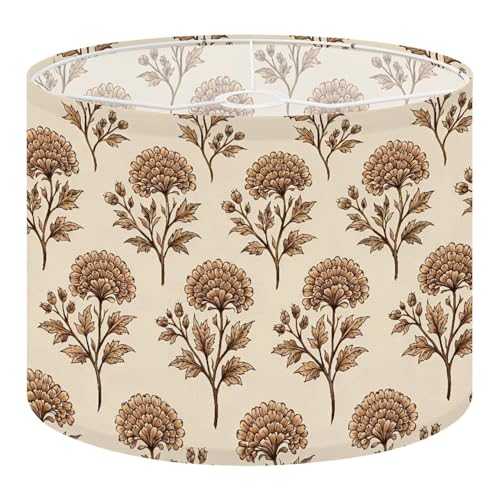
Lampshade Dimensions: Our table lampshades are 11 " Top x 11 "Bottom x 8.9" High. Our lampshade is different from others in that the inner hole size is 1.65 inches, so no harps are needed. They suit most table lamps, floor lamps, and pendant lights. Please carefully check the lampshade dimensions before purchasing to ensure they fit your fixtures.
3. Hand Painted Glass Lamp Shades

Glass takes paint differently than fabric, and that is the appeal: a floral design on a ceiling fixture or a small table lamp glows when the bulb is on.
Any shape or size of glass shade can carry flowers or a more complex scene.
Start with a small table lamp before attempting a large hanging fixture. Clean the glass well so the paint grips, and sketch your design on paper first.

Vintage Victorian Design:This9.8 inches (diameter) x 11.3 inches (height) Victorian-style velvet lampshade features an elegant bell-shaped silhouette with scalloped edges,crafted in a refined olive green tone for an authentic vintage look.Perfect for creating a classic Victorian or retro-inspired atmosphere.

SIGNATURE EXCLUSIVE: Designed with you in mind, we bring to you an offering that is utterly unique, found nowhere else in the world. We believe you are worthy of lighting decor as wonderful, elegant and beautiful as you. Decorate your household atmosphere with distinction

Overall dimensions of 6in L x 6in W x 11.75in H
4. Arts and Crafts Hand Painted Lampshades

Dragonflies on a green shade with a crackle finish give the look of the Arts and Crafts movement, where handwork and nature motifs came first. The cracked surface adds age without any fussy detail.
A gold-toned base suits this shade, because the warm metal pulls out the green in the paint. Keep the motif simple: a few dragonflies spaced with room around them read better than a crowded pattern.

Shade Dimension: Top diameter: 11.6 inch , bottom diameter:12.6 inch, height: 9.8 inch, screw thread diameter: 0.43 inch. Medium size suits most table lamps and floor lamps. Please check the shade size carefully to make sure they are suitable for your light fixtures before purchasing.

Lampshade Size: Height-8.9 inches, top diameter-11 inches, bottom diameter-11 inches, thread diameter-1.65 inches. Please check the size carefully before purchase to make sure it matches your lamp.

Perfect Size & Fit:Set of 2 consisting Brownish-white feather lampshades features a 10-inch top and bottom diameter (25.4 cm) and a 9-inch height (22.86cm).Before placing the order, please make sure to purchase according to the compatible size of your lampshade.,Thank you for your understanding.
5. Conical Hand Painted Lamp Shades

A conical shade tapers from a wide bottom to a narrower top, and that slope suits a sky scene. Celestial motifs on a bedside lamp fit a bedroom nicely, especially next to a small framed picture.
Because the surface curves, paint stars and moons in small shapes that won’t distort at the edges. Turn the shade as you work so your hand stays at a comfortable angle.

Ensure You Need the Right Size: Height - 8.9 inches, top and bottom diameter - 11 inches, screw thread diameter: 1.65 inches (Tips: Please check the diameter size of your...
6. Watercolors Hand Painted Lamp Shades

Soft birds and branches in watercolor suit white conical shades, because the pale surface lets blues and flower colors stay delicate. A set of 3 makes a pretty group for a shelf or a pair of side tables.
I would test the paint on a scrap of the shade material first, since washes behave differently on different surfaces. Work in light layers and let each dry before adding the next.

【Fringe Lamp shade Dimension】Top Diameter: 6 inch, Bottom Diameter: 13 inch, Height: 9.6 inch, Spider fitter hole diameter: 0.4inch, Tassel Height: 4 inch. Medium size suits most table lamps and floor lamps. Please check the lampshade size carefully to make sure they are suitable for your light fixtures before purchasing.

SIGNATURE EXCLUSIVE: Designed with you in mind, we bring to you an offering that is utterly unique, found nowhere else in the world. Without a doubt in our heart, we believe you are worthy of lighting decor as wonderful, elegant and beautiful as you. Decorate your household atmosphere with distinction

Glare-Free Eye-Caring: Four ribbed frosted glass shades soften harsh direct light into balanced, shadow-free brightness for makeup and skincare. The textured wall light filters strong beams to cut uncomfortable glare and relieve eye fatigue, much milder than transparent lamp shades
7. Lotus Flower Painted Lamp Shade

Pink lotus blooms on green stems suit a plain beige cylinder, because the neutral fabric lets the petals carry all the color. Against a light wooden tripod base, the whole lamp stays soft and a little Zen.
Pencil the flowers in first, spacing them so the stems climb the shade at different heights.
A cylinder has no taper, so a pattern stays even all the way around. Paint two or three blooms rather than a full border, and leave the beige showing between them.

Standard Compatibility: This Fabric Drum Lampshade is designed with a standard fitter, which features a center ring that screws directly onto the lamp base, making it compatible with E26/E27 sockets without requiring a harp. Its medium size, typically around 13 inches in diameter and 10 inches in height, ensures it fits most common table lamps and floor lamps. This universal fit makes it a straightforward Fitter Lampshade replacement option for updating a wide variety of existing lighting fixtures in your home.
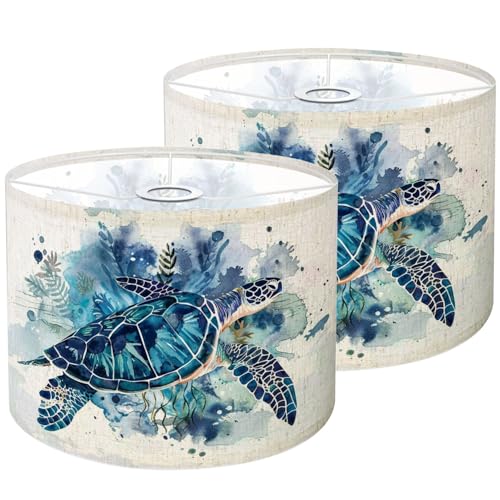
Lamp Shades Set of 2 Size: 11inches in top diameter, 11 inches in bottom diameter, and 8.9 inches in height, suitable for most table lamps, floor lamps, and pendant lights. The lampshade is suitable for E27 lamps, and can also be adapted to E26, E14, and 11mm by using the 3 adapter rings we complimentary
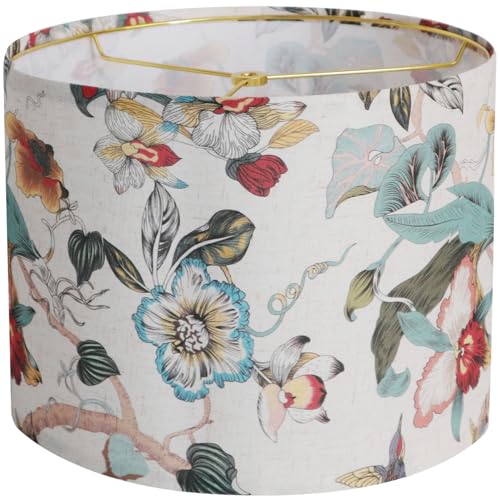
Dimension: Our medium-sized round lampshade (10" height, 13" top diameter, 13" bottom diameter) suits most table lamps, floor lamps and Nightstand lamps. Please check the shade size carefully to ensure it fits your light fixtures before purchasing
8. Cityscape Hand Painted Lamp Shades

European-style houses lined up around a cylindrical shade turn a lamp into a small street scene, and a clear glass base keeps the attention on the painting.
A straight-sided shade is easier to paint than a tapered one, since the rooflines stay level as you turn it.
Draw a light pencil line for the rooftops and another for the ground before adding any buildings.
Vary the heights and colors of the houses so the row doesn’t look stamped. Fine detail like windows takes patience, so plan on more than one sitting.

CREATE A SPOOKY HALLOWEEN GLOW: Bring your display to life with a hand-painted skeleton, jack-o'-lantern pumpkins, bat accents, and rich purple and orange tones-a striking centerpiece for mantels, desks, and parties

Precise Measurements for a Perfect Fit: Precision Fit & Sizing: Fitter base: 1.57" outer edge (1.06" inner) | Top diameter: 4" | Height: 5.9". Before placing your order, please measure the diameter of your lampshade holder accurately. Ensuring the right fit is crucial for a seamless replacement.

7 INCH FITTER 5-3/4 inch tall and 7-7/8 inch bulge
9. Minimalist Face Line Art Shades

A face drawn in one continuous line is about the easiest portrait a beginner can paint, and on a white shade it looks deliberate rather than plain. Colorful lines make each shade feel like its own character.
Sketch the contour in pencil, then trace it with a thin brush or paint pen in a single color per shade.
Keep eyes, nose and lips to a few strokes. A group of several in different colors looks best together, so paint them as a set and let the lines stay loose.

Faux laced oiled craft paper lamp shade with lacing on top and bottom

Search Press sewing lampshades book

Unique size design: Top 8.7 inches, bottom 8.7 inches, height 7.9 inches, screw thread 1.65 inches, we have adapters suitable for various lighting fixtures, drum lamp shade can be perfectly matched with a variety of lamps, lampshade can be easily integrated, adding a unique charm to your home lighting.
Identifying Hand Painted Shades
Tiny differences are the giveaway. On a floral design, check several leaves or petals side by side: in work done by hand, each one varies slightly in size, curve and stroke, while mass-produced shades repeat the same image exactly.
Decals and automation now make reverse painted shades far easier to produce, so a neat look alone proves nothing. A skilled eye is needed to catch the flaws, so look closely and in good light.
Skilled artisans painted the older shades by hand, and a few of them signed their work once it was done. Turn the shade slowly and check the lower edge and the corners of the design for a signature.
Value of Antique Painted Lampshades
Start with the maker.
Handel, Pittsburgh, Jefferson and Phoenix Pairpoint all made brass and copper lamps with reverse painted shades, and Pairpoint and Handel are the most valuable today. One Pairpoint Puffy lamp in mint condition recently sold at auction for $12000.
Check the wick finder and the flame spreader for a mark, logo or pattern, since that is where makers often stamped them and it can name the lamp.
A maker’s name gives you a sense of value, and it also helps if you need a matching replacement for a damaged shade.
Then check the glass. Because antique shades were usually hand blown or mold blown, a little unevenness in the glass and some random flaws are normal and even a good sign.
Some shades also carry bits of sand or debris left over from sandblasting. Glass that is flawless and uniform points to a modern factory piece.
Frequently Asked Questions
What kind of paint do you use on a lampshade?
Match the paint to the look you want. Watercolor suits soft, washed-out blends on those same surfaces, and thicker emulsion or chalk paint works for a solid base color or bold stripes, especially when thinned with water.
Before painting the real thing, try a swatch on a scrap of the same shade material, since the same wash can bleed on one surface and sit crisp on another.
How can you tell if a lamp shade was hand painted?
Look for small differences. Floral designs give the clearest clue: line up a few petals or leaves and look for small differences in size, curve and brush stroke, because a printed shade repeats the exact same image every time.
Decals and automated methods can now imitate reverse painting well, so hold the shade under bright light before you trust it.
How do you care for a vintage hand painted lamp shade?
A soft, dry brush is the safest way to dust an older shade; wiping can lift the paint.
Keep it away from direct sunlight, and leave spots alone rather than scrubbing. Use a weak, cool bulb such as a low-wattage LED so heat doesn’t harm the paint.