
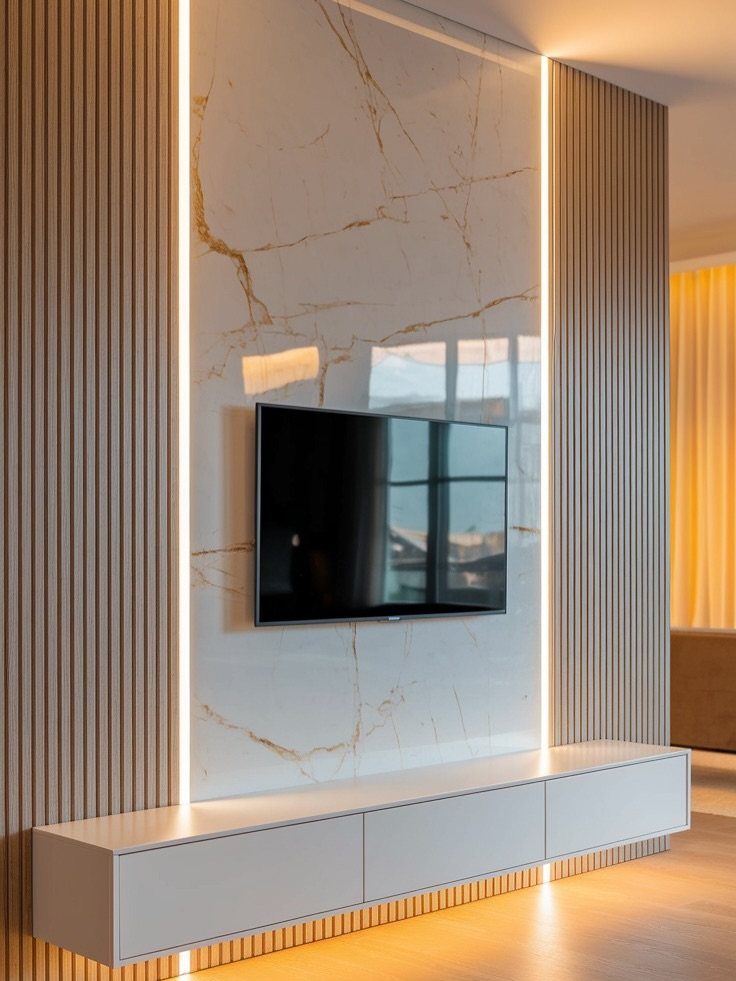
A TV unit can run from a floating shelf to a marble-backed feature wall that costs several thousand dollars, and the right choice depends on how much floor space you have, whether you can drill into the wall, and how much storage you need.
In a small apartment, a floating console clears the floor and keeps the room open, while floor-to-ceiling storage hides equipment and remotes in a space that has to work as your only living area.
1. Floating TV Unit

A wall-mounted cabinet or shelf keeps the floor clear and makes a room feel larger, which matters in apartments and smaller living spaces where every bit of visible floor counts.
The look stays clean because cords drop behind the unit or inside a chase, and cleaning underneath becomes easier.
Most floating units need secure anchors into studs, not just drywall. If the wall is plaster, toggle bolts rated for the combined weight of the unit, TV, and anything stored inside are the safe choice.
The visible gap between the unit and the floor needs to be large enough to make the floating effect clear without looking fragile.

Versatile Open Storage: Features compartments for routers, game consoles, DVDs, remotes, or decor, organizing media devices and essentials in any modern living space

Modern Construction: Crafted with 15mm particle board and white double-sided triamine, the TV cabinet features a sleek design with a high gloss UV finish for a contemporary look.

Multi-Port Charging Station & Ambient Lighting: The floating TV shelf features 3 AC outlets and 2 USB ports for easy charging of your TV, gaming console, Wi-Fi router, DVD and more. Plus, an adjustable LED light offers color customization for a cozy ambiance
2. Luxury TV Unit

This look combines materials like marble or stone veneer, high-gloss lacquer, integrated LED strips, and hardware in brushed brass or matte black to create a refined focal wall. The finish quality and the lighting make the difference.
Marble or porcelain slabs behind the TV add weight to the design, and when lit from above or below, the veining becomes a feature on its own.
I usually see this paired with a long floating console in a dark or neutral finish, which keeps the focus on the wall treatment rather than the storage.
The cost scales quickly.
A full marble wall can run several thousand dollars depending on the slab and the installer, and adding recessed lighting or custom cabinetry pushes the budget further. This setup suits larger rooms where the unit becomes the anchor, not filler.

Space-Saving Corner Design: Designed specifically for corners, this curved corner TV stand maximizes unused space and fits perfectly into small living rooms, apartments, or bedrooms. Ideal for creating a clean and organized entertainment area without taking up unnecessary floor space.(note: Widest 44" and Narrowest 21" curved desktop)
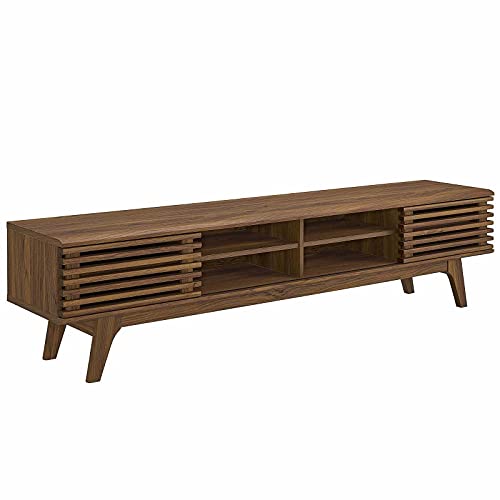
MID-CENTURY TV CONSOLE - Transform your living space with retro modern intrigue. An organic aesthetic, linear detail, and flared profile bring iconic style to this mid-century TV stand

[Accent TV Stand] : This TV stand features a simple and stylish design, perfectly matching your home decor style while adding a touch of elegance to your space
3. Wooden TV Unit

Natural wood tones warm up a living room in a way painted finishes do not, and the grain gives the unit texture without needing extra detail. Walnut, oak, and teak are the most common choices, and each ages differently.
A mistake I see often is pairing wood with too many other finishes.
If the unit is wood, keep the legs, handles, and any shelving in the same family or go minimal with metal accents in black or brass. Too many materials make the piece look pieced together.
Wood veneer over engineered board is lighter and more affordable than solid wood, and in a TV unit where the structure is hidden, the difference is mostly in edge banding and how the surface holds up to heat from components.
Solid wood handles weight better and can be refinished if it gets scratched or faded over time.

【Premium Wood Board】 Built from thick, waterproof, scratch-resistant engineered wood with a rich farmhouse finish, this entertainment center offers lasting durability and a timeless look. The 15.24" x 57.95" tabletop easily supports 32" to 65" TVs, providing a stable surface for family movie nights or game days.

Ample Storage Space: This tv console has 2 tiers open mesh shelves and 4 hooks, provides ample space to organize and display your media equipment, gaming consoles, DVDs, Xbox, PS4 and more. Keep your living room tidy and clutter-free.

【SIMPLE & RUSTIC FARMHOUSE STYLE】– If you are a fan of rustic farmhouse style and love to add some natural sense to your living room, then this stylish modern universal 50 inch TV stand is your best choice. Classic wood grain board and X-shaped metal frame that can perfectly match varieties of home decoration styles and reflect your special aesthetic.
4. Beige TV Unit

Beige holds a room together when you want the TV area to feel finished but not loud.
It works especially well in spaces with warm whites, light wood floors, or cream upholstery, where a darker unit would feel too heavy and a white one too stark.
Ribbed or fluted surfaces add dimension without colour, and they photograph well, which is why this style shows up often in styled living rooms.
The texture catches light and shadow, so the unit reads as detailed even from across the room.
If the unit is matte, it’s easier to wipe down than high-gloss.

Modern Industrial Aesthetic: This rustic brown TV stand combines urban elegance with practical design—with wood grain MDF panels and a black powder-coated metal frame. Its modern industrial-style TV stand design elevates your living room, bedroom, or office with bold, timeless style.

TV Stand with Power Outlets: The television stands overall size is 63" x 15.7" x 20.5" to support TVs for years to come, such as 50/55/60/65/70 inches TV. 4 standard plug outlets make it easy to hold and charge your TV, game consoles, DVD collections and other TV components
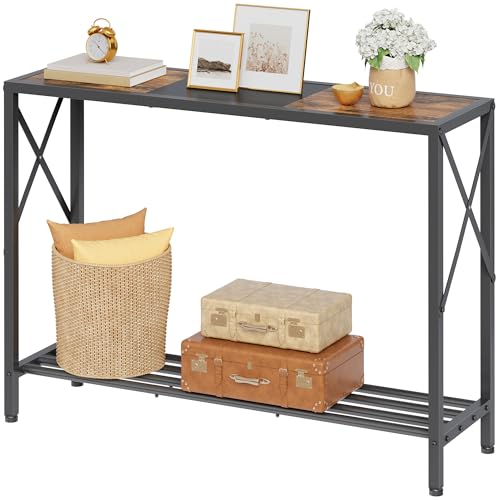
【Narrow Console Table 】Our sofa table creats more storage space for you. Perfect size at 41.8”L x 11.5”W x 30.2”H, you can put it in any narrow place.
5. Minimalist TV Unit
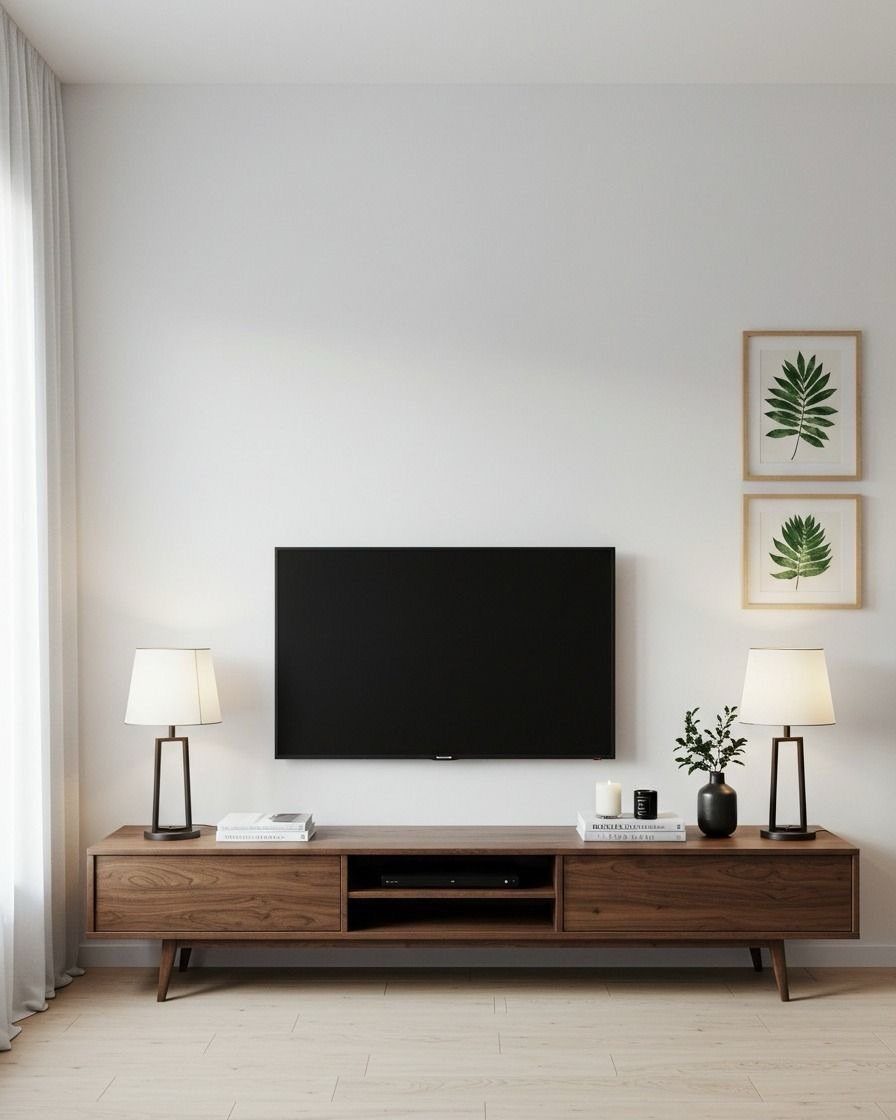
Clean lines and no extra detail keep the focus on the screen, which suits smaller rooms where a busy console would compete with everything else. This style works when storage needs are light and the wall should stay open.
I usually recommend a low profile so the unit sits close to the floor and the TV stays at a comfortable viewing height without a mount.
Open shelving or a single drawer keeps the form simple, and leaving space around the unit rather than filling the wall edge to edge makes the minimalist intent clear.
Wood, white lacquer, or matte black are the finishes I see hold up best over time. Avoid units with decorative legs or ornate hardware, which undo the simplicity immediately.

Passing the UL94 V-0 Rating test, a plastics flammability standard released by Underwriters Laboratories of the United States, UL94 V-0 Rating is defined as Burning stops within 10 seconds on a vertical part allowing for drops of plastic that are not inflames, which means it's safer than ordinary materials because of the higher flame retardancy and brings greater security to your daily use

Bye bye messy TV wires! Hung your TV up but the HDMI and Internet cords are dangling down. The clutter of wires is really hard to look at. The wires are directly exposed and inadvertent touch can be easily tangled with the cords, a potential electrical hazard. Don't want something bulky and not in a position to put the wires behind the wall, so the Yecaye TV cord hider is a good option
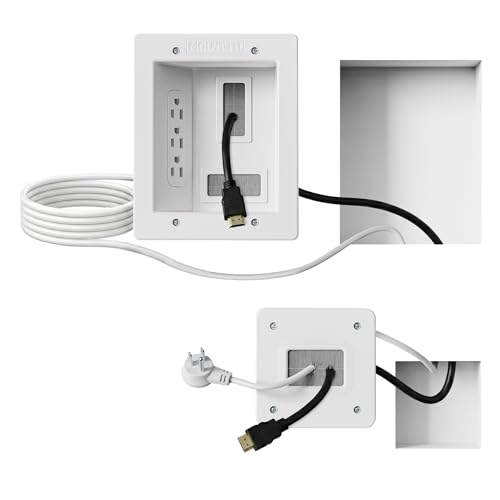
Organized home theater setup – Eliminate messy wires and give your entertainment area a clean, modern look. This in-wall cable management kit provides an easy way to power your TV and hide cables for a polished setup in living rooms, bedrooms, or home theaters.
6. TV Unit with Bright-Coloured Accents

Bright colour on the unit itself or on the wall behind it turns the TV area into a feature rather than something you’re trying to hide.
Purple, emerald, navy, or burnt orange all work when the rest of the room is neutral enough to let the accent breathe.
Fluted or paneled surfaces in a bold colour add depth, and when backlit, the grooves cast shadows that make the colour feel richer.
This approach works well in living rooms where the furniture is beige or gray and the space needs one strong moment without repainting everything.
The colour should either match an existing accent in the room, like a rug or artwork, or stand alone as the only bright note. Two unrelated bright colours in the same sightline rarely look intentional.
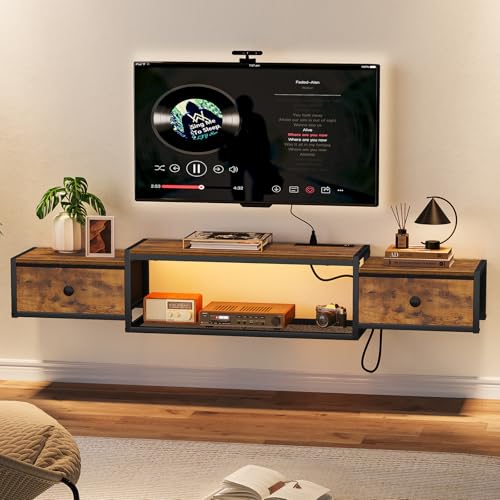
Save Floor Space: This wall-mounted floating entertainment center frees up floor space and creates a tidy living room. Measuring 63“ L x 11” W x 11" H, it accommodates TVs ranging from 32 to 75 inches. The open metal frame in the center allows for rapid ventilation and heat dissipation, making it convenient for storing electronic devices such as set-top boxes and game consoles.

Multifunctional Design: This floating TV stand serves as both a media center for your living room or bedroom, enhancing your viewing experience, and a storage unit. The cleverly designed drawers on both sides offer privacy while providing ample storage space for your room

Multi-Port Charging Station & Ambient Lighting: The floating TV shelf features 3 AC outlets and 2 USB ports for easy charging of your TV, gaming console, Wi-Fi router, DVD and more. Plus, an adjustable LED light offers color customization for a cozy ambiance
7. Textured TV Unit

3D textured panels add depth without color, and the relief catches light in a way flat surfaces cannot. White or off-white keeps the effect subtle, while the shadow lines shift as light changes through the day.
The panels go up with adhesive over drywall, and minor imperfections disappear, though anything larger than a small dent will telegraph through.
Most panels are made from gypsum, MDF, or PVC, and weight varies enough that anchoring matters if you’re mounting the TV into the same wall.
Dust settles into the grooves, so plan to vacuum or wipe them every few weeks if the texture is deep.

Storage Cubes, Easy Reach: 6 open storage cubes hold up to 22 lbs each for decor, remotes, and books. With no doors or drawers, everything stays visible and within reach—no digging, no clutter

[Ultimate Capacity & Universal Compatibility] Tired of messy game stacks? This video game storage tower features a tiered slot design that holds up to 23/46 game cases. Perfectly compatible with PS5 game holder needs, PS4 games, Xbox One storage, and Switch game storage. A universal game organizer for all your physical media.

Built-In Power Outlet: Equipped with 1 USB port, 1 Type-C and 2 AC power sockets, it can power TV/sound bar/game/night light devices,features cable management holes, which can effectively organize messy cables and keep your space neat and comfortable
8. LED-Lit TV Unit

LED strips behind or below the unit add soft light that makes the TV wall feel finished after dark without glare. The glow also reduces eye strain when you’re watching in a dim room.
I install strips along the back edge of a floating console or inside a recessed panel so the light source stays hidden and only the wash shows.
Warm white or a color that matches the room’s accent works better than cycling RGB, which reads more like a game setup than a living space.
Most strips plug into a standard outlet and come with an adhesive backing, but that adhesive fails on dusty surfaces, so wipe the mounting area with alcohol first.

Farmhouse Flair: This entertainment center features a wood-look finish, charming barn doors, and sleek metal knobs, creating a cozy and inviting atmosphere in your living space

Farmhouse Flair: This entertainment center features a wood-look finish, charming barn doors, and sleek metal knobs, creating a cozy and inviting atmosphere in your living space

【Convenient 2-drawer storage】Featuring two spacious drawers, this TV stand offers a practical solution for storing and organizing various items, keeping them easily accessible yet safely out of reach of children, ensuring a clutter-free and child-friendly environment.
9. Built-In TV Unit

A unit built into the wall reads as part of the architecture rather than furniture, and the storage wraps around the TV in a way that feels planned.
This approach works best when the living room has an alcove or a wall that can give up depth without shrinking the room.
The cabinetry can match existing trim or stay minimal with flush doors and no visible hardware. Open shelves break up closed storage and give you space for books or objects without the wall feeling too heavy.
Cost depends on whether the unit is custom or assembled from modular components, and installation usually requires a carpenter if the fit needs to be exact.

[Industrial Console Table]: Designed with clean-lined metal frame and natural wood grain shelves, this farmhouse sofa table exudes elegance and rusticity in your space. It features three long shelves that are ideal for displaying plenty things like books, decorative plants and frame photos. Keep clutter out of sight while lending a touch of industrial-chic look and classic beauty to your space, creating a welcoming atmosphere in your entryway

【Industrial Style TV Stand】This industrial style TV console can perfectly match your furniture of different styles. The dimensions of this TV table is 46.1"W x 11.4"D x 19"H. It is suitable for 43/50/55 inch TV.

Convenient Sliding Doors: Sliding barn door makes it easy to access the cabinets and shelves while adding a touch of vintage charm and quality metal rail ensures smooth and noiseless movement
10. Marble TV Unit

Marble or stone behind the TV adds material richness that paint alone cannot match, and the veining gives the wall detail even when the rest of the room is simple.
White marble with gray veining suits lighter spaces, while darker stone like black marble or slate works in rooms with deeper tones.
Large-format slabs read as more refined than smaller tiles, and when the slab runs floor to ceiling with minimal grout lines, the effect feels intentional.
Stone veneer is lighter and less expensive than solid slabs, and for a vertical surface where weight is not bearing load, the visual difference is small.
Heat from the TV will not damage stone, but mounting into it requires the right anchors.

Messy and Electric Hazard Solved: A cable dangling under the TV, a cord in the ceiling, a wire straying in the corner, these troublesome cables are unsightly and dangerous. DELAMU One cord hider, Small cord covers for wires on wall offers you a good idea. The days of messy and dangerous cables in your home are coming to an end with the TV cord hider for wall mounted TV

X-Large capacity 3pcs cable management kit: Designed to hide 1 to 5 cables, these cord hiders are perfect for multiple cable setups. Measuring 1.6 inch wide by 0.8 inch high, they can accommodate up to 4 HDMI cables or 5 Cat 6 Ethernet cables
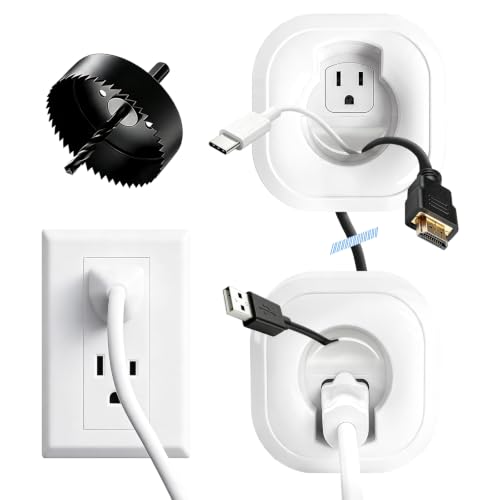
Premium In Wall Cable Management Kit: This practical in wall cable management kit acts as reliable cable management solution, great to hide wires along wall. It serves as perfect tv cord hider for wall mounted tv, effectively hide tv cords for wall mount tv and hide cords wall mounted tv, getting rid of messy exposed cables and presenting tidy wall decoration effect.
11. White High-Gloss TV Unit

High-gloss white reflects light and makes a small living room feel more open, which is why this finish shows up so often in apartments and narrow spaces.
The surface reads clean and modern, and it photographs well, but fingerprints and dust are visible from across the room.
A floating console in high-gloss lacquer keeps the look light, and pairing it with a textured or paneled wall behind the TV adds contrast without introducing color.
The gloss works best when the rest of the room is matte, so the shine stays intentional rather than overwhelming.
Lacquer scratches more easily than wood or laminate, so this finish suits rooms where the unit will not take daily wear.
12. Black TV Unit
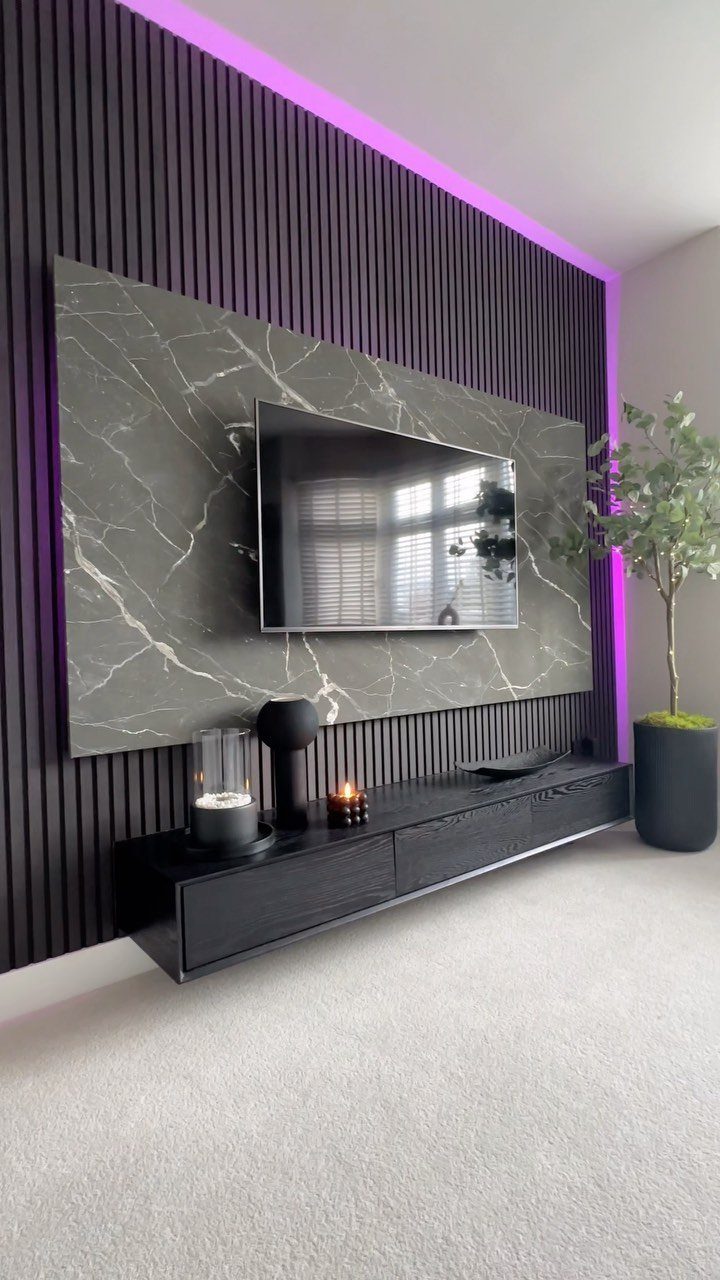
Black grounds a TV wall and makes the screen disappear when it is off, which is harder to do with lighter finishes. The look suits contemporary spaces where contrast matters more than softness.
A low black console keeps the sight line open and works well under a wall-mounted TV, especially when the wall behind is treated with stone, slats, or color.
Too much black in one area can feel heavy, so I usually balance it with lighter furniture or a rug that pulls the eye down.
Matte black hides dust better than gloss, and it suits rooms with warm or cool tones equally well.
13. Warm-Tone TV Unit

Honey-toned wood paired with warm lighting pulls a living room toward comfort rather than formality, and the combination works especially well in spaces where natural light is limited or the walls are cool white.
Slatted panels behind the unit add dimension without needing color, and when backlit, the shadow lines deepen the wood tone.
A low console in the same finish keeps the look cohesive, and leaving the top of the unit open rather than adding upper cabinets prevents the wall from feeling closed in.
This setup fits rooms where the seating stays neutral and you want warmth but no pattern or strong color.
14. Modern-Traditional TV Unit

A dark wood console with clean lines under a TV, set against paneled or molded walls, borrows the proportions of traditional furniture without the ornament.
The contrast between modern simplicity and classic wall treatment keeps the room from reading too spare or too formal.
Stone or lighter surfaces on top of the unit add a material break and reflect light, which helps when the wood finish is very dark.
This approach works in rooms with existing trim or wainscoting, where a purely modern unit would feel mismatched.
The paneling can be original or added, and painted white or left natural depending on how much contrast the room can hold.
15. Asymmetrical TV Unit

Shelving or storage that sits to one side of the TV rather than centered around it breaks up symmetry and opens the wall in a way that feels less formal.
Open shelves on the tall side give space for books or objects, and closed storage below keeps cords and components hidden. Lighting inside the shelves or along the back edge of the console adds depth without clutter.
This layout suits wider walls where the TV does not need to be centered, or rooms where a window or doorway already interrupts one side.
16. Rounded-Edge TV Unit

Rounded corners soften the silhouette and make the unit feel less severe, which matters in rooms where the furniture is angular or the space is small enough that sharp edges would feel harsh.
A floating console with curved edges reads lighter than a grounded piece, and the gap below keeps the floor visible, which helps when the room needs every bit of openness.
Underlighting in warm white makes the curve more visible and adds a glow that separates the unit from the wall.
This finish fits contemporary spaces that lean calm instead of dramatic, and it pairs well with light wood or neutral tones elsewhere in the room.
17. Gypsum TV Unit
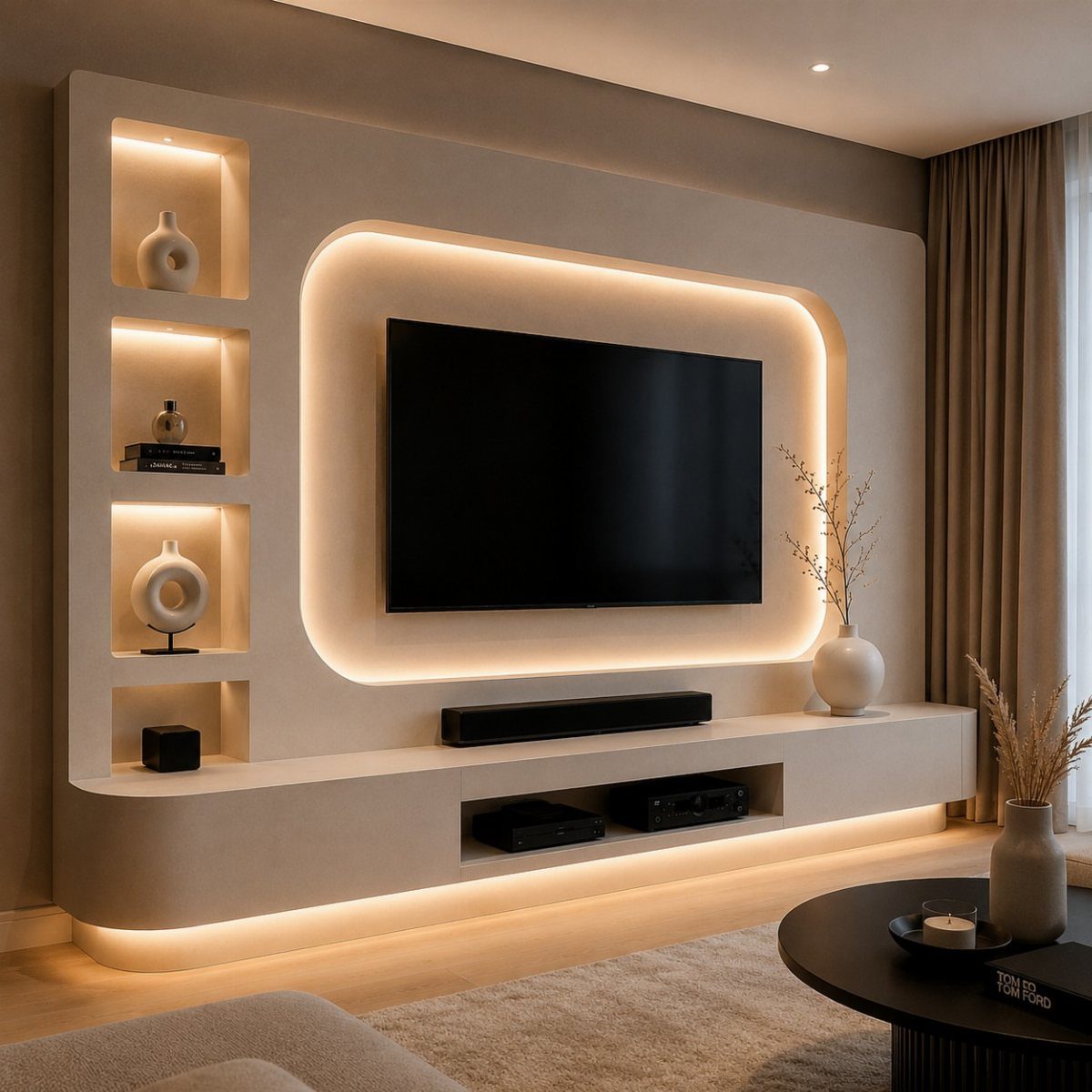
A built-in unit finished with smooth gypsum plaster creates a continuous surface that feels architectural instead of added. The material can be shaped into curves, recesses, or paneling, and when painted, it reads as part of the wall itself.
Integrated LED strips along the edges or behind the TV add definition without hardware, and the light washes the surface in a way that makes imperfections less visible.
This approach works best in new builds or renovations where the wall can be framed out to accommodate depth.
Gypsum takes paint well, and the finish can be refreshed without replacing anything. The cost is weight and permanence; this is not a piece that moves with you.
18. Under-Staircase TV Unit
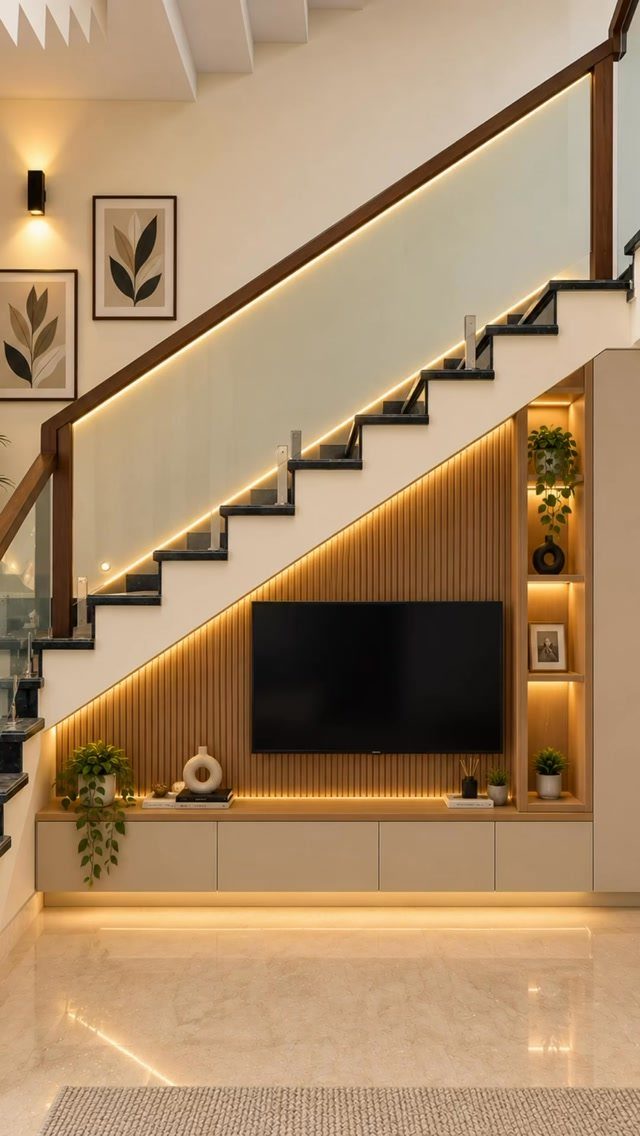
The angled wall under a staircase is often wasted, and mounting the TV there turns that dead zone into the focal point. Slat panels or built-in shelving that follows the slope keeps the setup from feeling like an afterthought.
Lighting behind the slats or along the base makes the recess feel intentional and adds depth to a space that might otherwise read as tight.
The height of the TV depends on the slope of the stairs, and in some layouts, the lower mounting actually improves the viewing angle from a seated position.
This setup suits open-plan homes where the stairs are visible from the living area, and it frees up the main walls for seating or windows.
19. Floor-to-Ceiling TV Unit

A full-height unit fills the wall and gives you far more storage than a low console, which matters when the living room doubles as the only place to keep books, equipment, or anything you need close but out of sight.
The mix of closed cabinets and open shelves keeps the wall from feeling too heavy, and leaving a few sections open lets you change what is on display without committing to one arrangement.
20. Industrial TV Unit
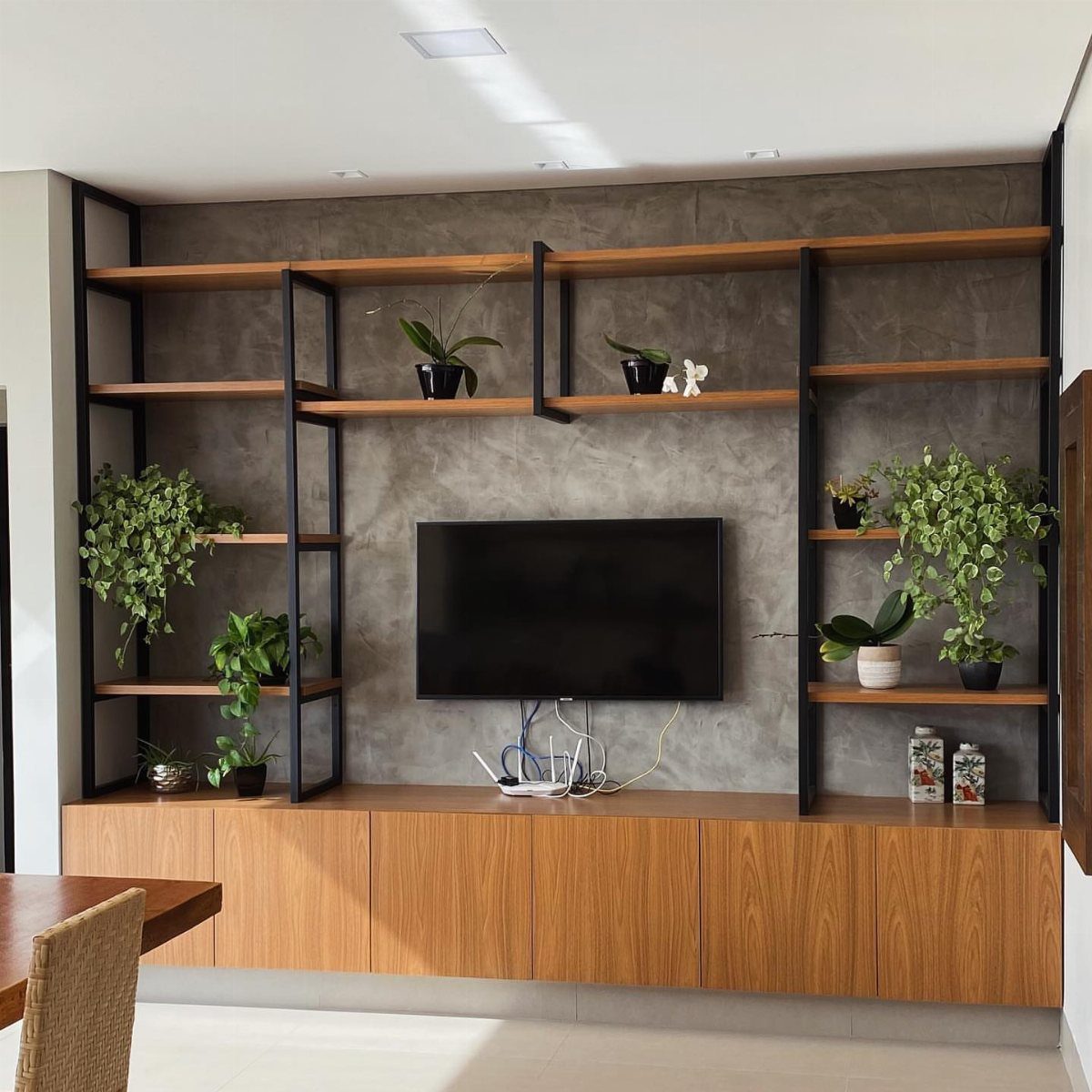
Metal frames with wood shelves and a concrete-finish wall give the setup an unfinished look that reads urban without leaning too industrial.
The open shelving keeps the wall from feeling closed in, and the mix of materials adds texture in a way that all-wood or all-metal cannot.
Black metal suits rooms with darker tones, while raw or galvanized finishes work when the rest of the space is lighter.
The open frame also makes it easy to add or remove shelves as storage needs change, and running cables through the structure is simpler than with closed cabinetry.
This approach fits spaces where exposed brick, concrete, or metal beams are already present.
21. Scandinavian TV Unit

Light wood slats paired with a white floating console keep the look minimal and functional, which is the point of Scandinavian design.
The warmth comes from the wood, and the white keeps the wall from feeling too heavy, even when the unit wraps around the TV.
A glass cabinet adds vertical storage without blocking light, and leaving it open or lighting the interior keeps the display from feeling closed off.
This setup works in small living rooms where too much dark wood or closed storage would make the space feel smaller, and it pairs well with light floors and neutral furniture.
The finish is clean enough that clutter shows immediately, so this look only holds up when the shelves stay edited.
22. TV Unit with Display Cabinet

A tall glass cabinet next to the TV adds vertical storage and display space without taking up floor area, and lighting the interior makes the cabinet a feature rather than something that fades into the wall.
Yellow or warm white light inside the cabinet draws attention to what is on the shelves, and the glass keeps the wall from feeling closed in the way solid cabinetry would.
The fluted panel behind the TV adds texture, and the low console below keeps the floor line open.
This setup suits living rooms where the TV wall has enough width to hold both the screen and the cabinet without crowding the seating area.
23. Floor-Standing TV Easel Stand

A slim floor stand holds the TV on a narrow pole that takes up almost no floor space, which works in rooms where wall mounting is not an option or where you want the ability to move the screen.
The stand keeps the setup minimal, and the TV sits at a height that can be adjusted without tools.
This approach suits apartments where drilling into walls is restricted, or spaces where the layout changes often enough that a fixed mount would not make sense.
The thin profile works best when the rest of the room is equally spare, because the stand does not hide cords or components the way a console would.
24. Gallery Wall TV Unit

Art hung around the TV makes the screen feel like part of a gallery wall instead of the only thing on it, and the mix of frames and colors pulls the eye across the whole wall rather than just to the center.
A low white and wood console keeps the setup grounded without adding visual weight, and the neutral finish lets the art carry the color.
The frames should vary in size but stay close enough in scale that the wall feels composed rather than random.
This layout works when the TV is smaller and the wall is wide enough to hold several pieces on either side without the arrangement feeling cramped.
25. TV Unit with Overhead Plant Shelf

A floating shelf mounted above the TV gives you room for plants without taking up floor space or blocking the screen, and the greenery softens the wall in a way that wood or stone alone cannot.
The shelf should sit high enough that the plants do not interfere with the TV’s ventilation or sight line.
Trailing plants like pothos or string of pearls work well because they grow down rather than out, and grouping several small pots reads better than one large planter.
This setup fits light-filled rooms where the plants will actually survive, and it pairs well with neutral consoles that let the green stand out.
26. Wood Slat Accent TV Unit

Vertical slats add texture behind the TV without pattern or color, and when backlit, the shadow lines give the wall depth that a flat painted surface cannot match.
The slats can run floor to ceiling or stop at a ledge where the console begins, and spacing them generously keeps the look open.
A floating white console below contrasts with the wood and keeps the floor line visible, which matters in smaller rooms.
Underlighting along the console edge or behind the slats makes the setup feel intentional rather than decorative, and the warm glow works better than cool white in most living rooms.
27. TV Unit with Integrated Fireplace
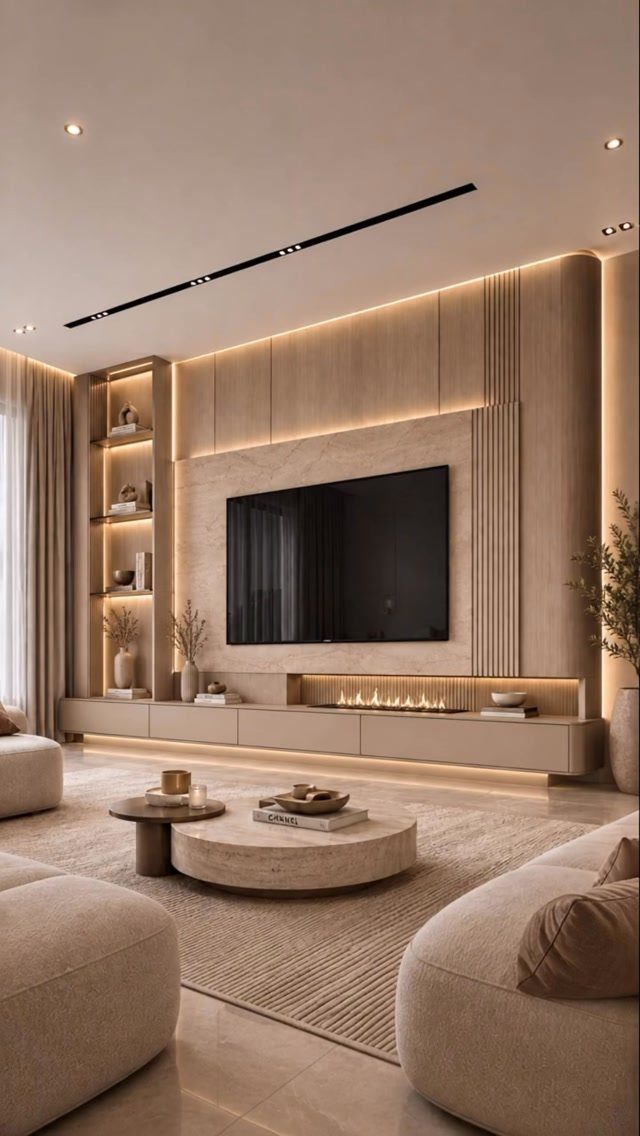
Mounting the TV directly above a linear fireplace consolidates two focal points into one wall, which works when the room is too small to give each its own space.
The heat from most electric fireplaces stays low enough that it will not damage the TV, but the screen should sit well above the flame to keep the viewing angle comfortable and the mounting hardware cool.
A low console to one side holds components without interrupting the fireplace, and paneling around the setup frames both elements.
This layout suits open-plan rooms where the seating area needs warmth and entertainment in the same zone.
28. Recessed Wall Niche TV Unit

A recessed niche frames the TV and shelves as part of the wall itself, which reads cleaner than surface-mounted units and gives the setup an architectural finish.
The recess needs depth, and the drywall has to be framed out before finishing, so this approach only makes sense during construction or a gut renovation.
The floating console below keeps the floor open, and the wood finish suits rooms where the rest of the furniture stays neutral.
29. TV Unit with Floating Corner Shelves
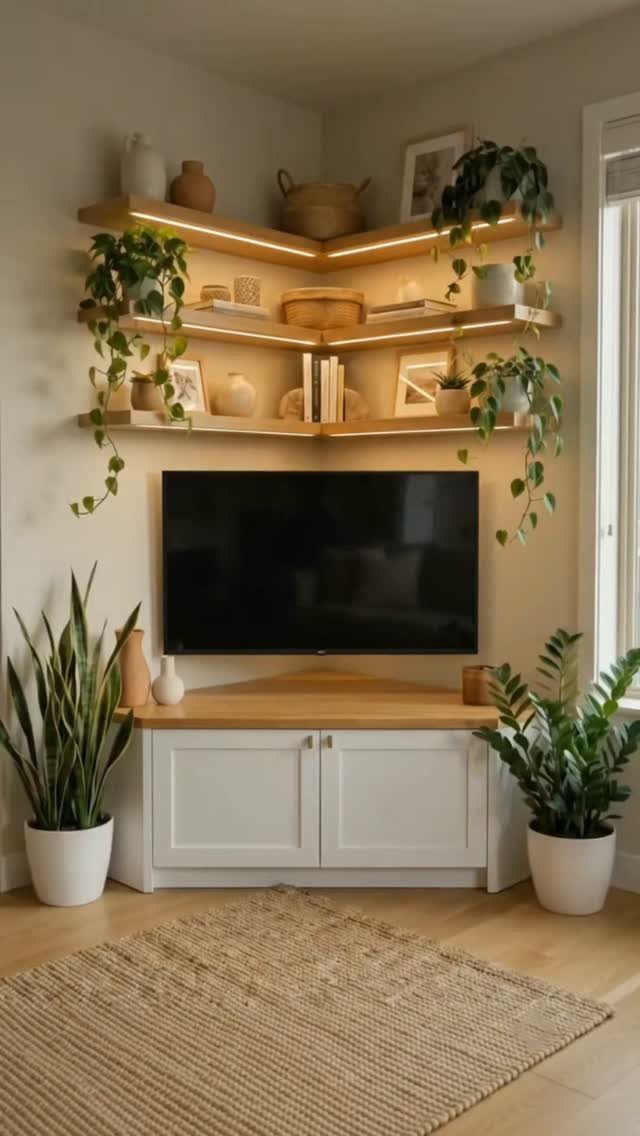
Stacking floating shelves in the corner next to the TV uses vertical space that would otherwise stay empty, and the warm LED strips along the back edges make the shelves feel like part of the design instead of an add-on.
The shelves should sit close enough to the TV that the grouping reads as one setup.
Small plants or objects on each shelf keep the arrangement from feeling cluttered, and leaving the top shelf open rather than packed gives the corner room to breathe.
This layout works in smaller living rooms where floor space is tight and you need storage without adding a tall cabinet.
30. Open Frame Metal and Wood TV Unit

An open metal frame with wood shelves keeps the TV and storage visible from all sides, which suits rooms where the unit sits in the middle of the floor or divides 2 spaces instead of backing up to a wall.
The white metal frame stays light, and the natural wood shelves add warmth without heaviness.
The open structure makes it easy to run cables through the back, and the shelves can hold components, books, or objects without the unit feeling overloaded.
This approach fits studios or open-plan spaces where the TV needs to be seen from more than one angle, and it moves easily when the layout changes.
Choosing Size and Proportion
Measure the wall first, then the TV, then add clearance. The unit should extend at least 4 inches past each side of the screen so the TV does not look like it is balancing on too small a surface.
In smaller rooms, that margin can shrink to 2 inches if wall space is tight, but less than that and the proportion tips into awkward.
Viewing distance sets scale. The unit should be slightly wider than the TV screen, with room around it so the arrangement does not look cramped.
In a wide great room, a single short console can read as undersized; flanking storage or a longer run fills the wall better.
Leave 3 feet of clearance in front of the unit for circulation. Furniture too close to the TV wall makes the room feel cramped even when the unit itself is the right size.
Frequently Asked Questions
What is TV unit design?
A TV unit is furniture built to hold the television and provide storage for media equipment, remotes, and anything else you need within reach of the screen.
The right unit keeps cords hidden, balances the proportions of the TV, and sets the tone for the rest of the room.
What makes a TV unit design luxury?
Materials like marble, solid wood, or high-gloss lacquer separate a luxury unit from a standard one, along with details like integrated LED lighting, brushed brass hardware, and seamless construction.
Proportions matter more than size, and a unit that fits the TV and the room will always look more finished than one that tries to dominate the wall.
What size should the TV unit be relative to the room and TV?
The unit should extend slightly wider than the TV screen to anchor the wall without crowding it.
In smaller rooms, a low floating console keeps sightlines open, while larger spaces can support a full-height unit or built-in cabinetry. Proportion matters more than a specific measurement.
Which materials should I pick for durability and aesthetic appeal?
Walnut, oak, and teak hold up well and age in a way that adds character, while marble and stone bring weight and texture that painted surfaces cannot match.
Metal accents in black or brass add contrast without overwhelming the wood, and high-gloss lacquer or matte finishes each suit different maintenance preferences.
Glass and acrylic keep the unit feeling light, but you’ll be wiping prints and dust off them constantly.
What finishes give the best premium look?
High-gloss lacquer reflects light and makes a smaller room feel bigger, while matte finishes in dark wood or stone settle the space and hide fingerprints.
Mixing materials, like pairing wood with metal hardware or adding a stone slab behind the TV, creates contrast that feels intentional. Natural stone finishes and warm lighting deepen the effect.
How important is cable management and hidden storage?
Hidden compartments and cord channels keep the wall from looking cluttered, which matters more as the finish quality rises.
Most units include space behind or below for routing cables, and drawers or closed cabinets hold remotes and equipment out of sight. A clean surface makes the design work.
What are common mistakes to avoid in luxury TV unit designs?
Mixing too many finishes in one unit, marble with high-gloss lacquer and heavy metal hardware all together, pulls the eye in too many directions instead of letting the design settle.
An undersized console below a large TV throws off the proportions, and skipping lighting leaves the wall flat. Choose materials you can maintain, since marble stains and gloss shows fingerprints.
What budget should I expect for a luxury TV unit?
Wood veneer, decent hardware, and basic LED lighting fall in the mid-premium range, while solid wood, stone slabs, and custom built-ins climb quickly depending on your installer and materials.
Finish quality and custom work drive the price harder than the footprint of the unit. A well-built unit lasts longer and holds its look over time.