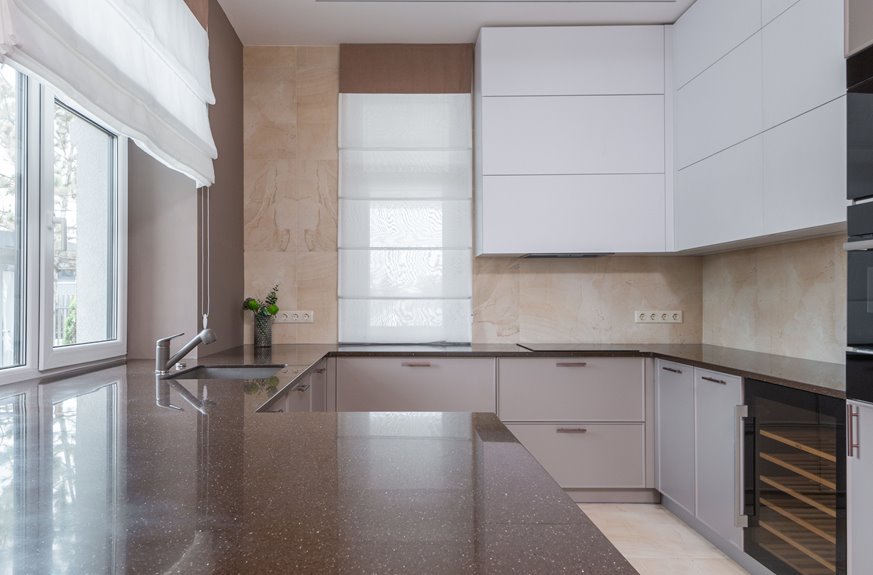
I just replaced my own kitchen countertops last spring, and it cost me just under $4,000 for premium quartz in a modest galley layout.
Most homeowners nationwide pay between $1,850 and $4,450 in 2026, though budget laminate jobs can dip as low as $900 and sprawling showpiece kitchens, think those swoon-worthy Waterworks spreads in Architectural Digest, easily cost past $8,400.
Your final number hinges on square footage, material choice (laminate at $30-50 installed versus Calacatta marble hitting $150), plus add-ons like ogee edges and sink cutouts that stack up fast.
Measuring twice and grabbing three itemized quotes will help you avoid costly mistakes and unexpected expenses.
There are templating tricks and red flags to spot before you sign anything.
Kitchen Countertop Replacement Costs in 2026
So I get asked about countertop costs probably twice a week, and I love helping someone nail their budget.
Your countertop replacement in 2026? You’re looking at roughly $3,138 nationally, though most of us land between $1,850 and $4,450. My own reno crept closer to $4K; a classic mistake where I got greedy with the quartz.
Material cost eats your wallet first. Laminate is your bargain option at $20-$50 per square foot, while granite and quartz run $80-$200 installed. Installation costs pile on another $40-$200 per square foot depending on complexity, cutouts, and whether you’re relocating that stubborn sink.
Small kitchens sometimes escape at $900; I’ve seen dream setups hit $3,600. Your square footage, edge details (ogee finishes cost more), and local labor rates ultimately determine your total cost.
Countertop Replacement Costs by Kitchen Size
Small kitchens (around 30 sq ft) typically run $900 to $3,600 for countertops. Medium kitchens cost $1,500–$6,000, and large kitchens (70+ sq ft) range from $2,100 to $8,400 or more. A galley kitchen that appears small may have more square footage than expected, significantly affecting the final budget.
Small Kitchen Estimates
When I tackled my first tiny galley kitchen, all 28 square feet of faded linoleum chaos, I nearly fainted at the quote. Then I laughed when I realized I’d been measuring in inches like an amateur. Small kitchen countertops cost significantly less than expected, which makes joining the renovation club accessible. You’re looking at roughly $900–$3,600 for your average 30-square-foot space, depending on material and installation specifics. Laminate runs about $8–$27 per square foot plus $30–$50 for professional installation. This option works well for first-timers testing their DIY skills. Quartz and granite jump to $80–$140 installed, but even then, your total stays manageable. Compact spaces have a real advantage: less square footage means you can invest in premium materials like Calacatta without excessive cost.
Medium Kitchen Pricing
Why do medium kitchens feel like the sweet spot where dreams meet reality? You’re talking about that glorious 50-square-foot zone where you’ve got space to actually cook, but you’re not hemorrhaging cash.
You’re looking at roughly $1,500 to $6,000 for countertop replacement. That’s quite the spread, so let me break it down.
Laminate is your budget option, clocking in around $900 to $1,500 for basic setups. Granite and quartz are where medium kitchens truly shine. These materials let you achieve a high-end look without the mansion budget.
Watch those sneaky add-ons though: fancy edge profiles, backsplashes, cutouts for your farmhouse sink. If your layout has curves, seams, or an island, regional labor rates will push you toward that upper range. Complex installations typically cost 20-40% more due to additional labor requirements.
Large Kitchen Expenses
So where does your kitchen land on the “I could host a cooking show” spectrum? If you’ve got 70+ square feet of counter space, welcome to the big leagues, friend. Your installed cost will likely hit $2,100–$8,400+, and that’s before you fall in love with granite that makes your wallet weep.
Large kitchen expenses break down as follows:
| Cost Factor | What You’re Looking At |
|---|---|
| Granite & natural stone | $80–$200+ per sq ft |
| Quartz alternatives | $80–$120 per sq ft |
| Extras (cutouts, edges, haul-away) | $50–$150+ each |
My dream soapstone choice, inspired by Pinterest, ballooned quickly. Labor, demolition, and fancy ogee edges add significant costs in sprawling layouts. Engineered surfaces offer an attractive alternative that maintains visual appeal without the expense of natural stone.
Countertop Material Prices Compared: Laminate to Marble
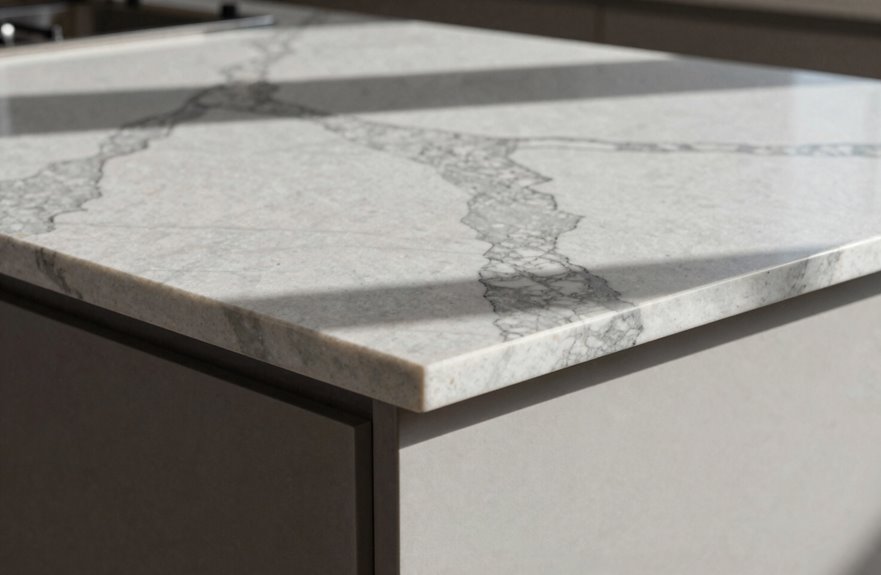
I’m excited to walk you through how different your countertop costs can be depending on what material you choose. Laminate runs about $8 to $27 per square foot, plus another $30 to $50 for professional installation. Marble costs $70 to $150 installed, with Calacatta slabs running $40 to $100 before fabrication.
The price varies significantly based on installation factors like edge profiles, which can add $10 to $40 per linear foot for decorative options like ogee edges. Whether you’re adding an integrated backsplash or installing one separately also affects the total cost. Quartz ranges from $15 to $70 installed, while granite spans $10 to $140. For a small galley kitchen, both materials offer viable options worth comparing before making your decision.
Material Cost Comparison
When helping friends navigate countertop options, granite is a natural stone choice ranging $10–$140 installed, depending on whether you select builder-grade or premium quality. Quartz, an engineered option, costs $15–$70 and resists staining well for households with children. Laminate remains the most budget-friendly choice at $30–$50 installed total. Marble, such as Calacatta gold, runs $70–$150 with fabrication included. Edge profiles and backsplashes add $10–$40 to the final cost.
Installation Price Factors
Every countertop I’ve fallen in love with at a showroom has sucker-punched my wallet later, and I’m betting you’ve been there too. Let’s talk installation costs, because this is where dreams meet reality.
| Material | Base Price (sq ft) | What You’re Really Paying For |
|---|---|---|
| Laminate | $8–27 + $30–50 install | That retro diner vibe |
| Quartz | $15–70 installed | Durability without the drama |
| Granite | $10–140 installed | Quarry prestige |
The real expense emerges with edge profiles, which add $10–30 per linear foot, and backsplash integration represents another budget line item. Those fancy ogee edges and seamless backsplashes transform kitchens, but they cost significantly more. My friend Sarah learned this with her Carrara-inspired quartz. It was gorgeous, but the final bill was steep.
Quartz vs. Granite: Understanding the Price Gap
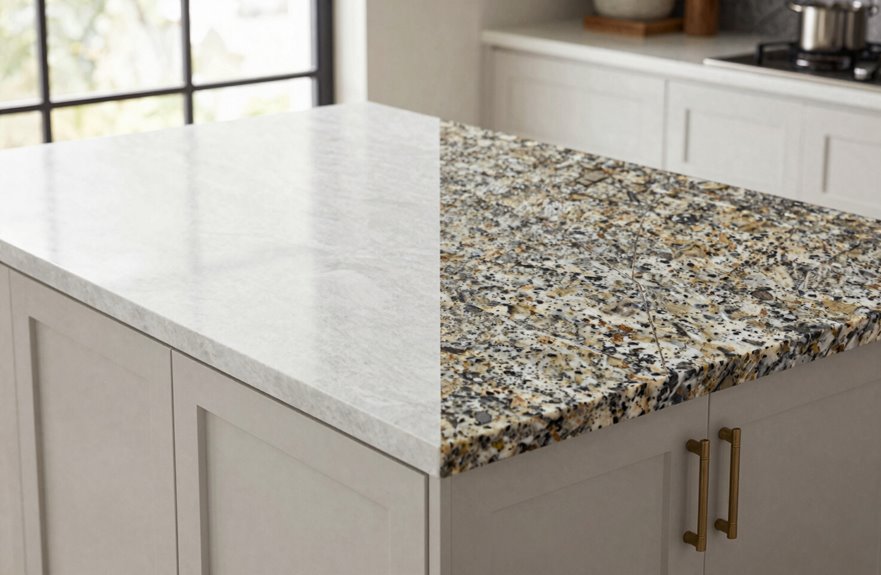
Why does choosing between quartz and granite feel like picking sides in a family feud? Staring at slab yards can feel like betraying someone.
Quartz typically runs $80–$120 per square foot, while granite spans $80–$200. Quartz offers engineered consistency, so you’re paying for predictability. Granite’s natural variability means that Brazilian Blue Pearl might cost double what your neighbor’s Uba Tuba did.
For a 50–70 square foot kitchen, quartz lands around $4,000–$8,000 installed, with granite potentially hitting $12,000 depending on stone origin and those gorgeous ogee edges visible on Pinterest.
Premium edges add $10–$40 per linear foot for either material. Granite’s pricing fluctuates with quarry availability, while quartz stays steadier. Quartz resists stains more effectively than granite, reducing maintenance requirements and long-term upkeep costs.
DIY vs. Professional Countertop Replacement Installation
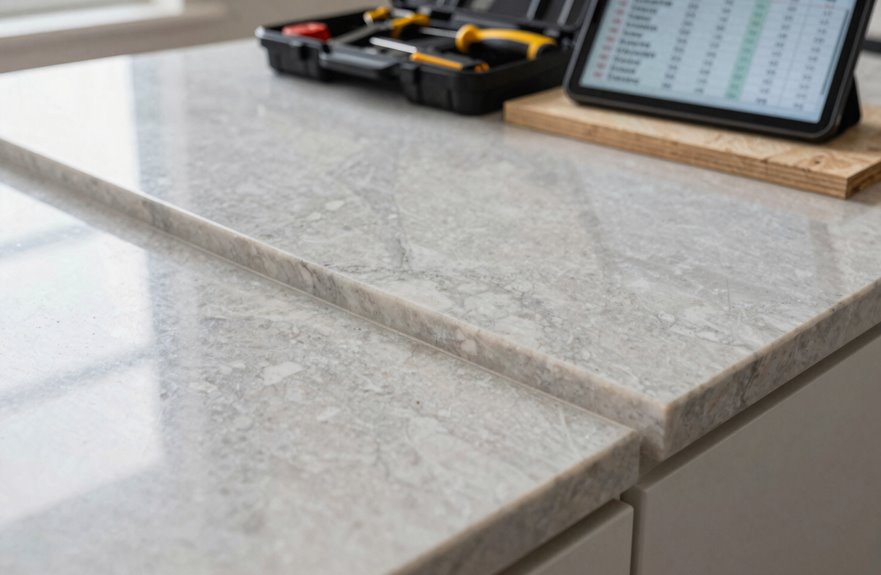
While DIY countertop replacement can reduce labor costs from that $40–$200 per square foot total, you risk compromising precise templating, seam alignment, and sink cutouts. Professional crews bring templating technology, fabrication precision, and warranty-backed installation. They also handle the demolition and quartz dust that will coat your kitchen for months if you attempt the work yourself.
DIY Cost Savings
When I’m staring at my sagging laminate counters and imagining that Calacatta quartz gleaming under under-cabinet lighting, I can’t help but wonder whether I should grab my level and YouTube my way through this, or call in the pros.
Professional installation runs $40–$200 per square foot for replacement labor alone, plus another $10–$30 per square foot for extra labor depending on your material. That veined marble I’ve been pinning requires complex installation techniques. Demo and haul-away costs add $2–$6 per square foot, plus disposal fees hitting $50–$300, and sink cutouts cost $50–$150 each. Going DIY means I’m pocketing that cash.
However, I’ve seen my own shaky tile work. Misleveling means expensive repairs, and precise templating isn’t exactly my superpower. The financial savings remain tempting, but the risk of costly mistakes from improper installation techniques could quickly erase those benefits.
Professional Installation Benefits
I’m absolutely terrible at measuring twice and cutting once, which is exactly why I recommend hiring professionals for this job. You’re not alone in wanting this done right the first time.
The professional installation benefits justify the investment when considering DIY disasters like wonky bathroom vanities. Kitchen countertop installation by pros means precise templating, gorgeous edge profiles like ogee and bullnose, and proper leveling throughout. Countertop replacement cost runs $40–$200 per square foot plus demo fees, but you receive proper fit, warranty coverage, and no emergency repairs. Complex layouts with integrated backsplashes and multiple sink cutouts are handled with expertise. Many installers offer 18-month interest-free financing, allowing you to spread that investment out and achieve a finished kitchen appearance.
What Drives Countertop Installation Labor Costs
Why exactly does installing a slab of stone (or laminate, or whatever you’ve chosen) cost so much more than the material itself? Labor accounts for the difference. Installation alone tacks on $10–$30 per square foot, and that’s before demolition ($2–$6 per square foot, plus dump fees).
Your kitchen’s layout matters significantly. Tight corners require more templating time, and those fancy ogee edges demand pure craftsmanship. Cutouts for sinks or stoves run $50–$150 each. Backsplashes typically appear as a separate line item. Professional fabrication versus DIY templating changes everything. Skilled hands transform raw material into the finished product you’re seeking.
When Removing Old Countertops Adds to Your Bill
You’re already shelling out for that gorgeous Calacatta Gold, and then someone reminds you the old laminate has to go first. That removal cost sneaks up like an uninvited plus-one at your dinner party.
Demolition and haul-away typically run $2–$6 per square foot, and don’t forget disposal fees. Another $50–$300 depending on your local dump situation. Some contractors itemize “remove and dispose existing countertop” separately, which provides clear transparency.
Tearing out old counters runs $2–$6 per square foot, plus dump fees. Itemized line items keep your contractor honest.
If your crew needs extra equipment, expect $40–$200 per day in rental costs. If your cabinets or plumbing need temporary disruption, labor costs increase for site protection.
Removing existing surfaces lets you upgrade properly. Watch those adjacent fixtures carefully. Damaged cabinetry mid-project creates significant complications and delays.
How Kitchen Layout Complexity Affects Replacement Pricing
Where do I even begin with my galley kitchen nightmare? Kitchen layout complexity turned my budget upside down, and yours might too.
Let’s talk square footage first. More space means more material, obviously, but it’s the weird angles that kill you. My L-shaped counter with that awkward corner resulted in extra fabricator charges just for the templating. I watched him trace it three times.
Edge profiles multiply fast when you’ve got turns and cutouts everywhere. My friend’s simple straight run featured a standard eased edge. My nightmare included bullnose, half-bullnose, and custom corners that added significant costs.
Demolition crews struggle in tight spaces too. Removing my old laminate around irregular cabinets took considerably longer, and that haul-away fee was substantial.
Longer lead times mean living with plywood for extended periods. The timeline for complex layouts directly impacts your budget and inconvenience during the replacement process.
Replacement Add-Ons: Edges, Cutouts, and Backsplash Upgrades
How quickly do those “small extras” spiral into budget monsters? I’ve watched it happen.
Edges seem innocent enough, but that sleek ogee profile (so Pinterest-worthy.) runs $10–$40 per linear foot. Meanwhile, I prefer a basic pencil edge. My wallet thanks me.
Cutouts? Each sink or stove opening hits $50–$150+, and suddenly my dream farmhouse sink costs double. I learned that the hard way on my last reno.
And backsplash upgrades? Integrated or separate, they’re gorgeous but expensive. That Calacatta marble extending up the wall is stunning. My bank account is less thrilled.
Demolition sneaks in too, costing $2–$6 per square foot plus disposal fees.
These add-ons add up fast. The costs accumulate while renovation budgets remain fixed.
How to Get Accurate Countertop Replacement Quotes
Those add-ons nearly flattened my renovation budget last spring, so now I review quotes with careful attention to detail. I grab at least three quotes from different fabrication shops, demanding they itemize everything: material, installation, labor, demolition, edge profiles, backsplashes, and every sink cutout. No hidden costs.
I bring my actual stone samples (that leathered quartzite I saw in Elle Decor last March) so contractors price identical materials. I measure twice, include my total square footage, and note that cost per square foot drops with bigger kitchens. Tiny galley owners pay more per unit. I also demand timelines; delays blow budgets fast. Fabrication lead times vary significantly, so I lock those details in writing before signing anything.
Smart Ways to Reduce Your Countertop Replacement Cost
What happens when you’ve fallen hard for that Calacatta marble in Architectural Digest but your bank account won’t support it? I’ve been there, ogling those waterfall edges while my wallet faced serious constraints.
Here’s how I cut my installation cost without sacrificing style, or at least without sacrificing much.
| Smart Swap | Your Savings |
|---|---|
| Standard edge profiles | $10–$40/linear foot |
| Laminate over granite | 60–70% material cost |
| Multiple quotes | Hundreds, sometimes thousands |
I grabbed three bids last spring and brought my stone preferences. That’s when I finally understood why square footage matters. Demo, removal, sinks, backsplashes, they all pile on. Laminate’s come far in recent years. The new patterns rival natural stone aesthetics. My kitchen looks magazine-worthy, and I still afford avocado toast.
Fair Countertop Pricing: Red Flags and Green Lights
Scoring a deal on laminate instead of marble felt like winning, but I almost got burned by a contractor who quoted me half what others charged. Learn to spot the difference between steals and scams.
Fair granite and quartz pricing sits between $80–$200 per square foot installed. Anything below this range indicates cutting corners, like the “bargain” contractor who ghosted me mid-project. Watch for vague installation costs too; legitimate professionals itemize labor ($10–$30 per square foot) and demolition ($2–$6 per square foot).
Green lights include detailed quotes, material allowances you can verify, and timelines that feel realistic rather than rushed. Ask neighbors about their countertop experiences; community experiences provide valuable insights. Another red flag is pressure to pay everything upfront.