
Where the power can reach decides which of these ideas fits your yard, because every run needs a plug-in power connector at one end and a sealed cap at the other.
Some spots fail on logistics alone, like a fence line with no outlet nearby or eaves where the rope has no tidy place to stop, so when money is tight, one run down a single edge of the walkway still does the job.
The range runs from that one unbroken line to wrapped trunks, lit rooflines and rope bent into sun shapes.
1. Walkway and Pathway Borders
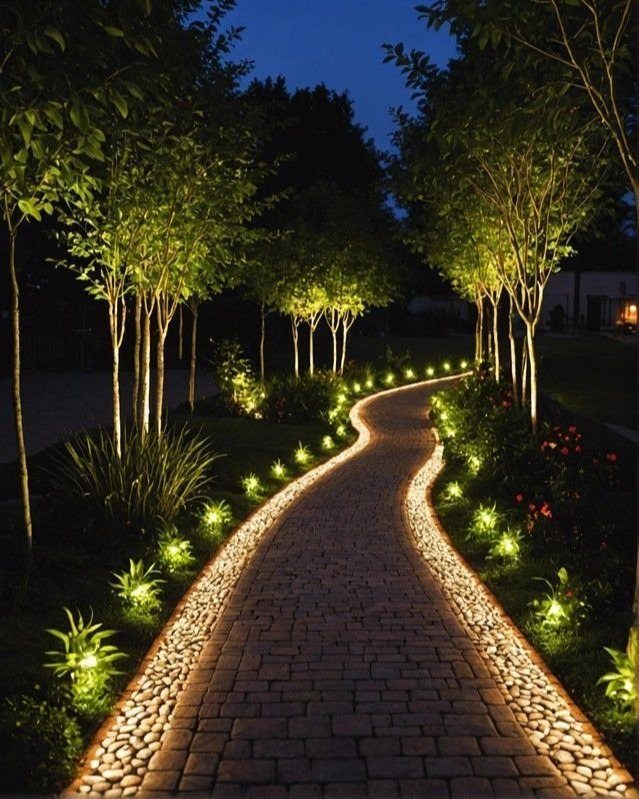
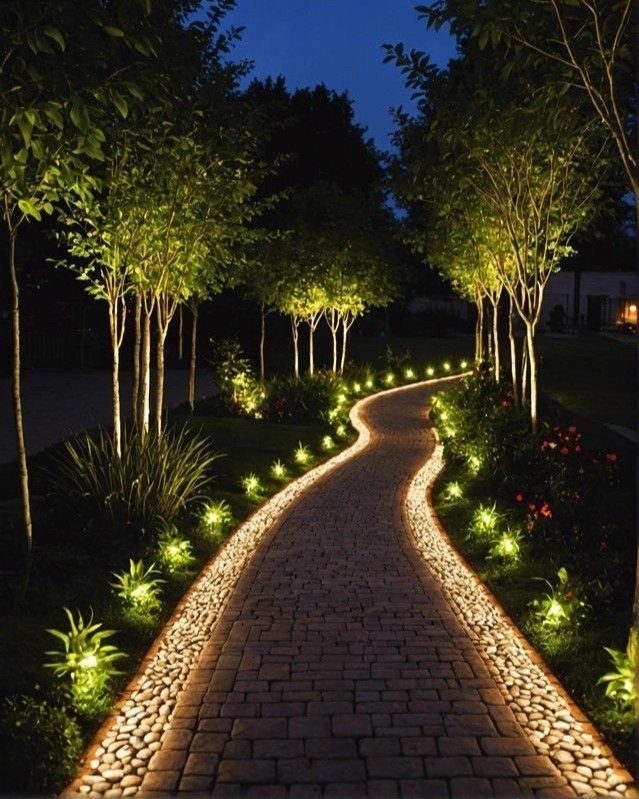
A continuous line of rope light along each edge tells people where the path goes before they reach the first bend.
On a winding route, follow the curve of the stones rather than cutting across it, so the glow reads as one smooth outline.
I prefer lighting both sides over just one. The path looks balanced, and the plants beside it catch some of the spill.
Warm tones sit best against stone and foliage.
2. Under-Rail Deck Lighting
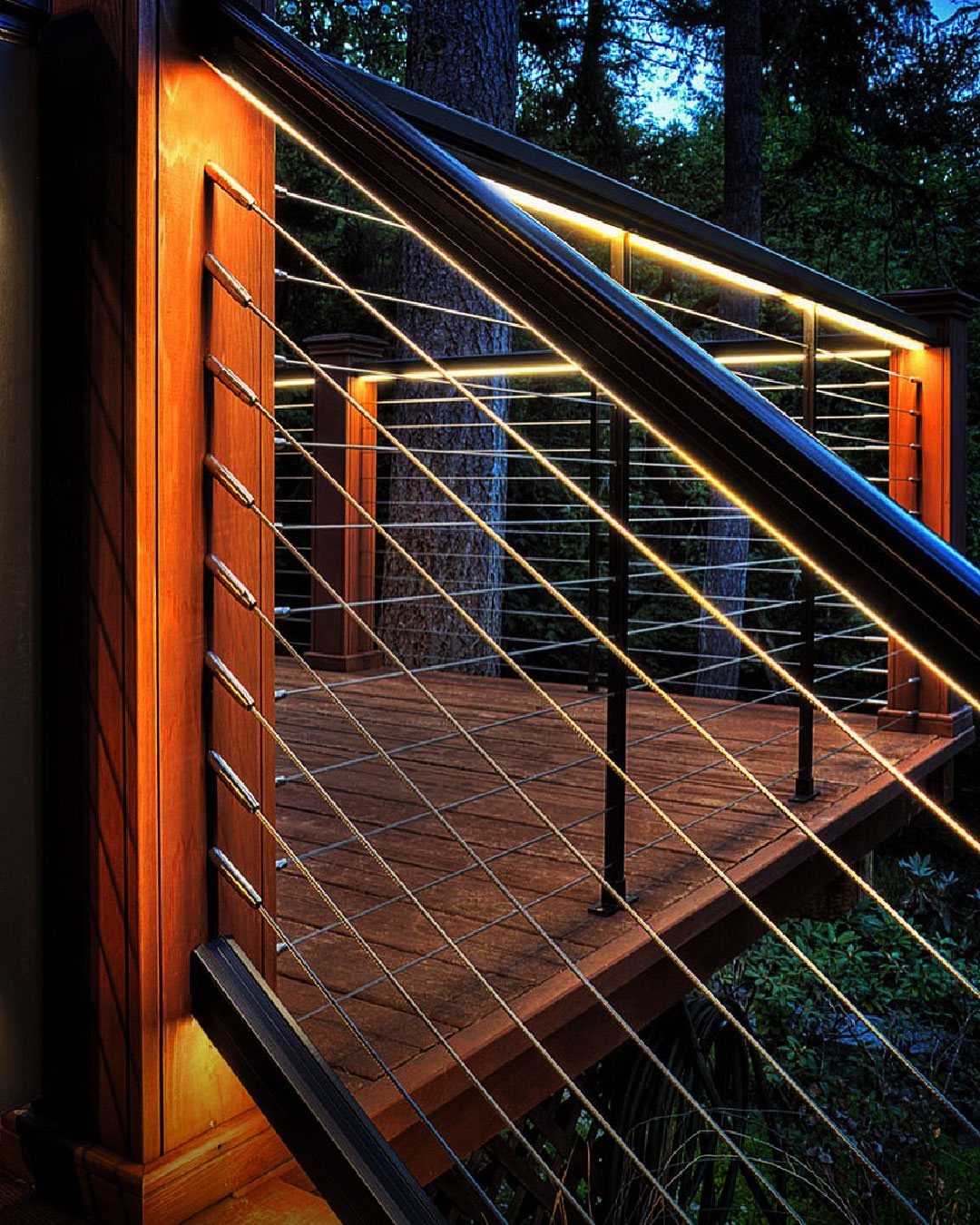
Tucked under the top rail, rope light stays out of sight while its glow falls on the deck boards below.
Mount it on the underside so the bulbs face down and nobody sitting on the deck stares into a bare line of light.
Warm yellow flatters wood, and a dark rail hides the cord well. Run it the full length of the rail so the pool of light stays even from one end to the other.
3. Wrap Trees and Posts
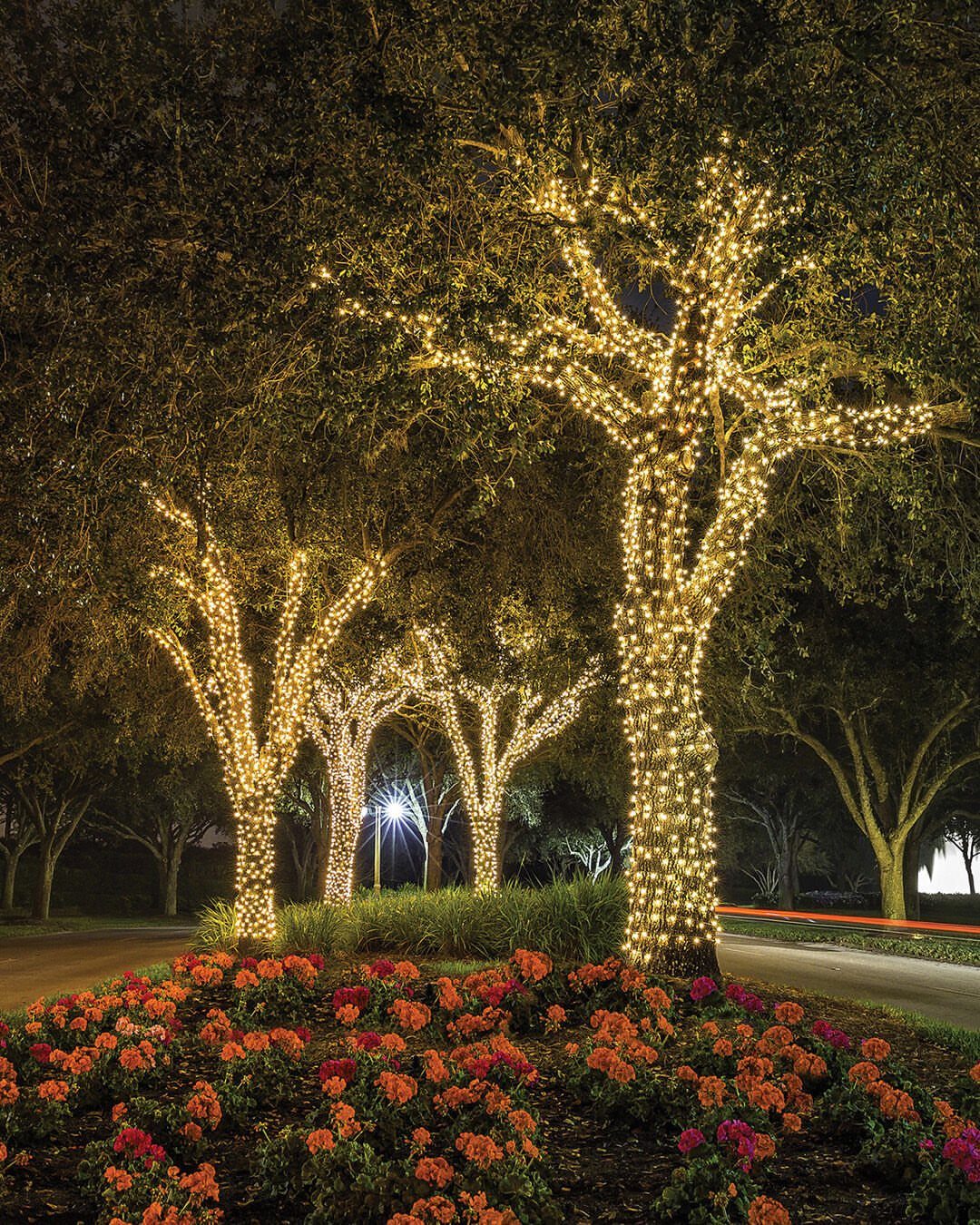
Trunks and branches wrapped in warm white light become the brightest feature in the yard, and a flower bed underneath gets lit as a bonus.
Spiral from the base upward, then follow the main branches, keeping the gaps between turns even so the glow looks deliberate.
Tighter spacing gives a brighter tree. Posts and columns take the same treatment, which is a good way to tie a porch or pergola into the planting.
4. Deck Perimeter Lighting
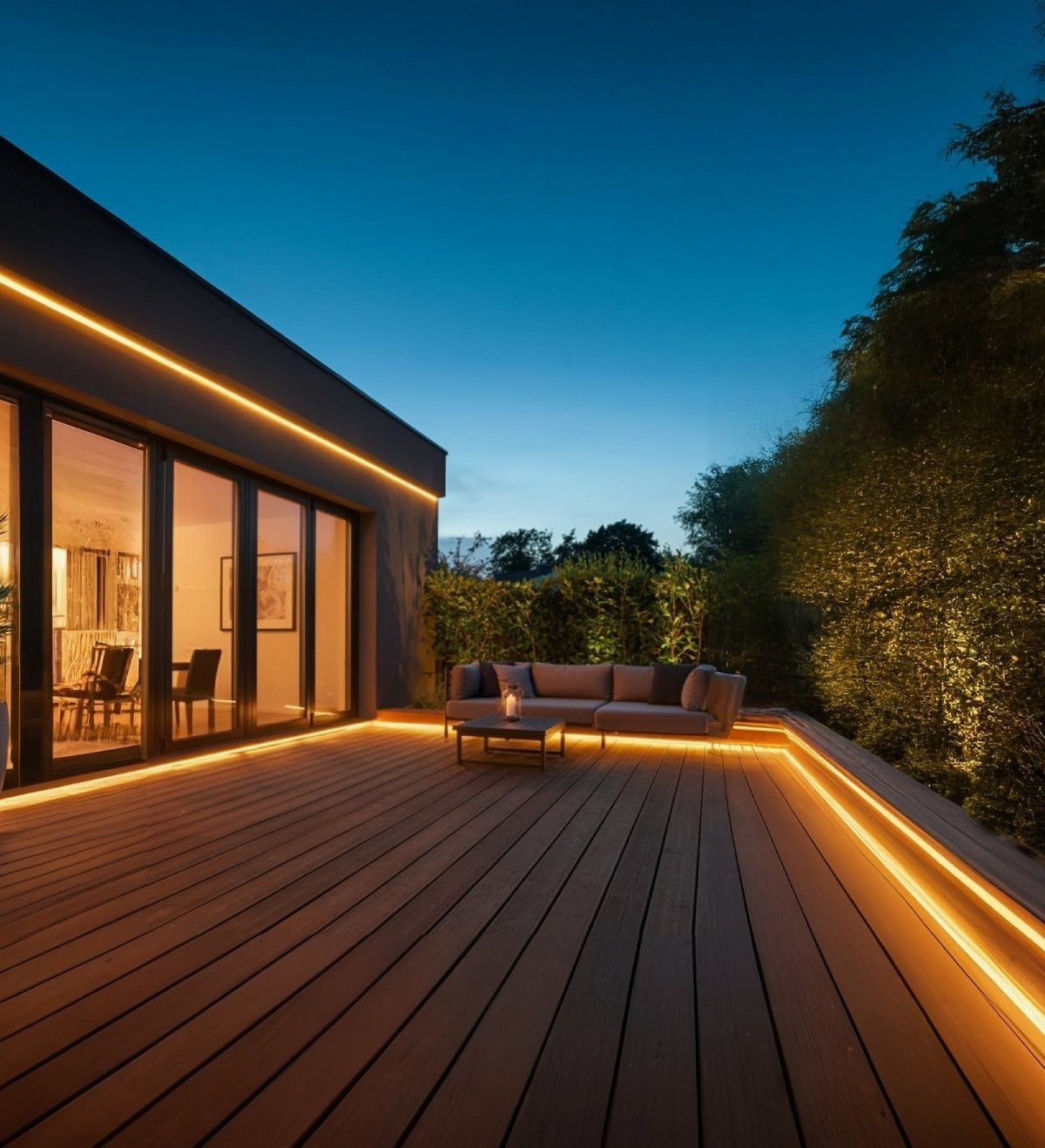
Where the deck meets the house and where it meets the lawn, a line of light draws the room’s boundaries.
Run rope light along the house edge and the outer perimeter, and the seating area starts to feel like a defined space instead of a platform in the dark.
I’d pick a warm orange glow, since it suits wood boards and a grey sofa. Keep the line unbroken at the corners; gaps there are the first thing the eye catches.
5. Steps and Stair Lighting
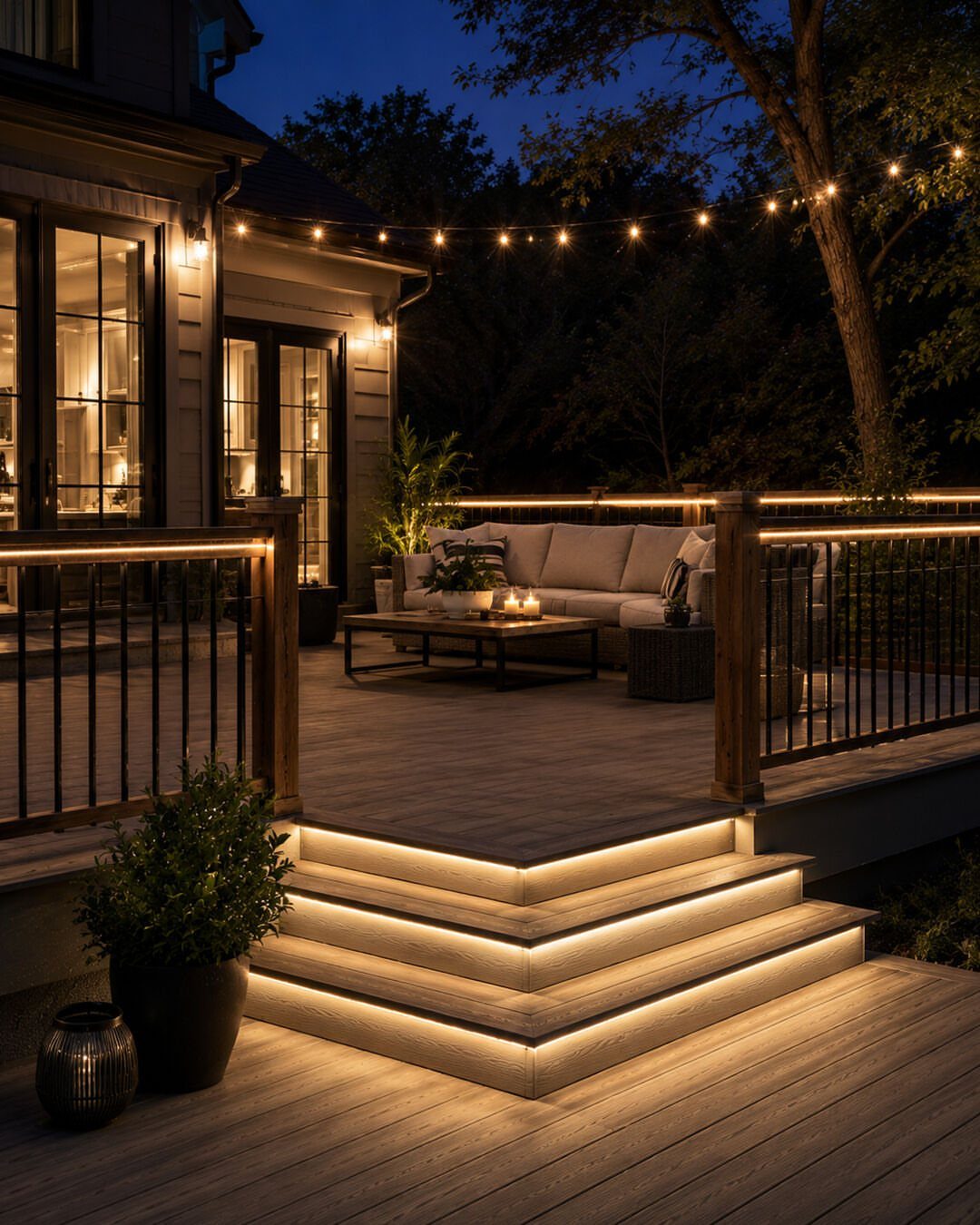
Anyone coming down in the dark needs to see where each step ends. Rope light along the stair edges shows exactly that, so mark every step instead of only the top and bottom.
Run the light under the front edge of each tread, where it lights the step without glaring up at people. Warm yellow works well beside the railing, and it sits comfortably under string lights overhead without competing with them.
6. Rope-Lit Patio Wall
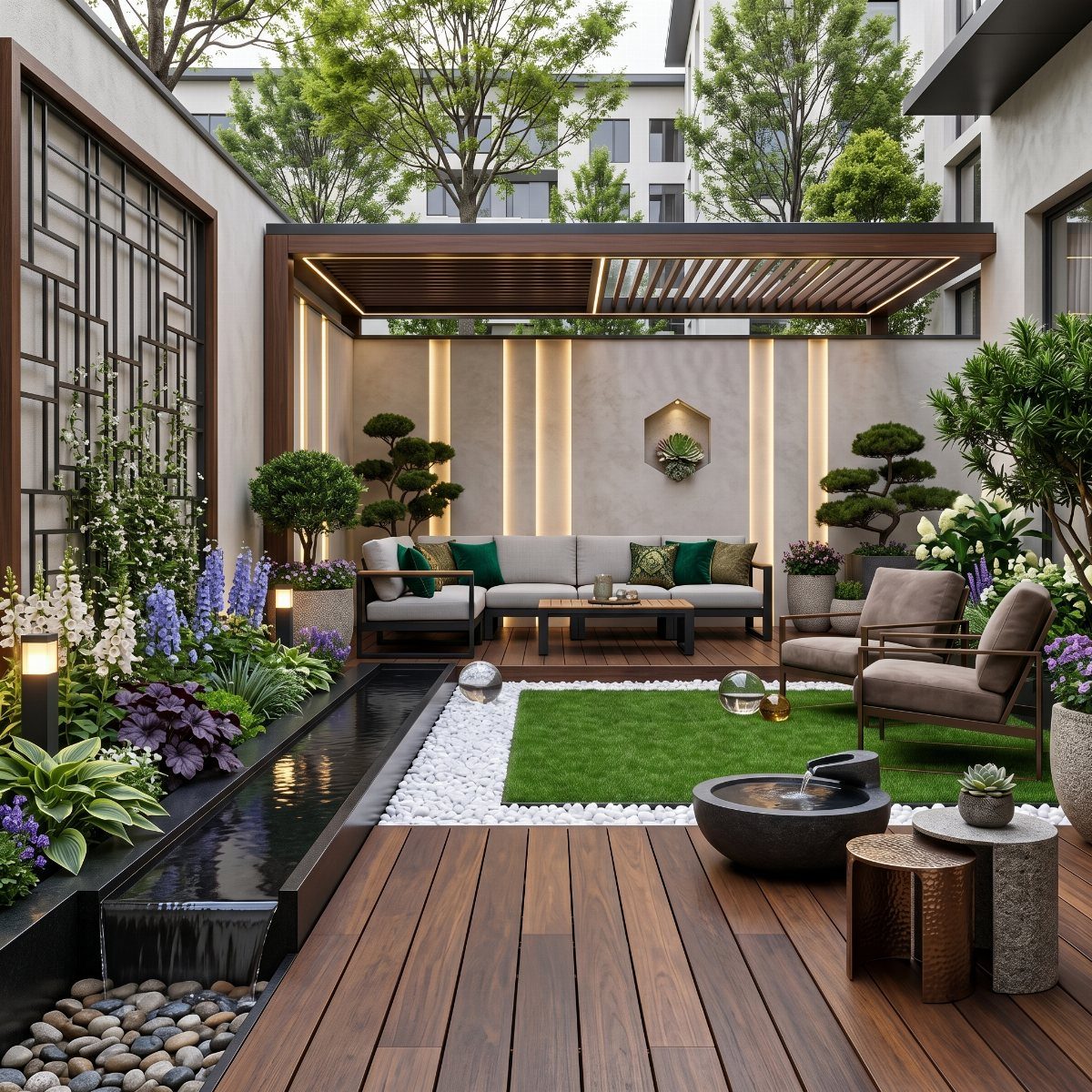
Vertical strips on a wall give a patio a different rhythm than the usual horizontal runs. Space them evenly, and add a linear light line in the pergola ceiling as a second layer overhead.
Match the warmth of both so they read as one scheme. More lines mean more cords, so plan where the power connects before you mount anything.
I’d keep the wall strips to a few clean lines rather than covering the whole surface.
7. Rope Lights Along a Low Wall
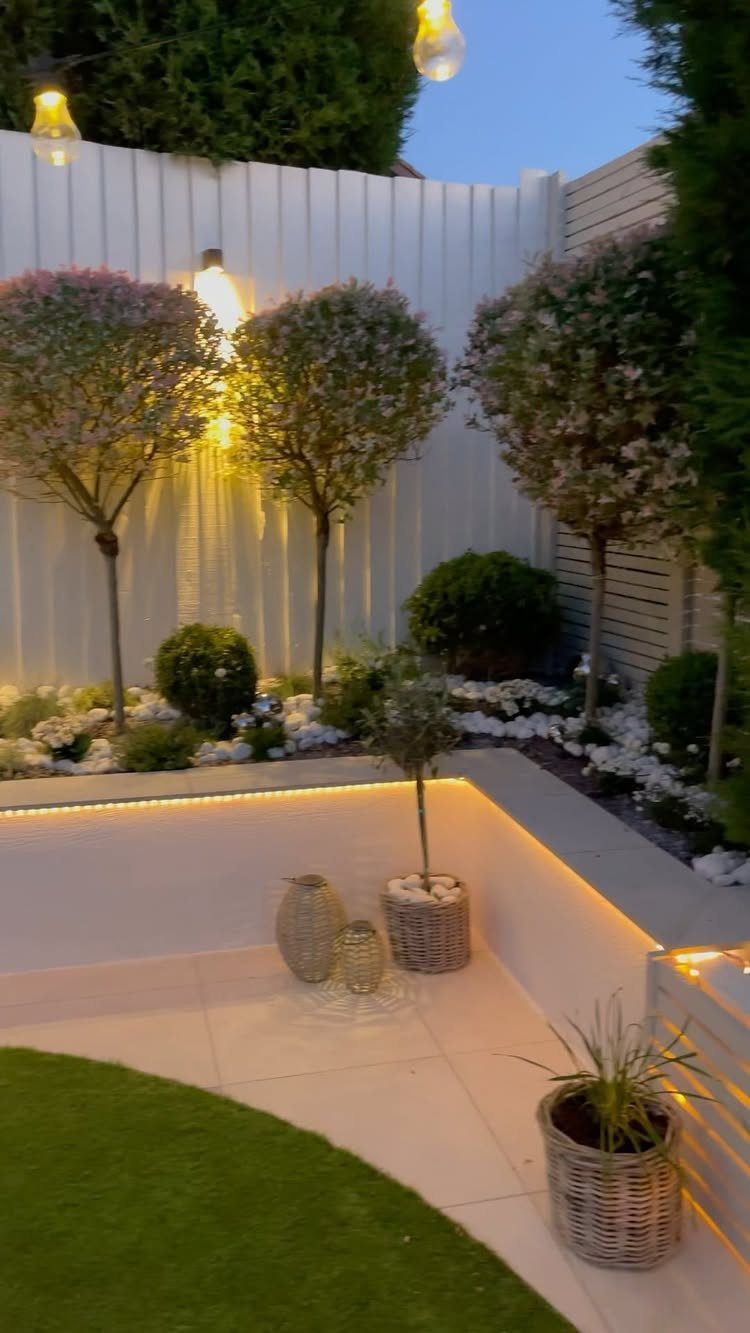
Run along the foot of a low wall, rope light washes the white face with a gentle, even warmth and picks out the pebbles and plants in front of it.
Keep the line continuous along the base so the wall reads as one clean edge.
I’d stay with warm tones here. Against white paint, a cool tone turns stark fast, while warm light keeps the seating area relaxed.
8. Rope-Lit Eaves and Porch
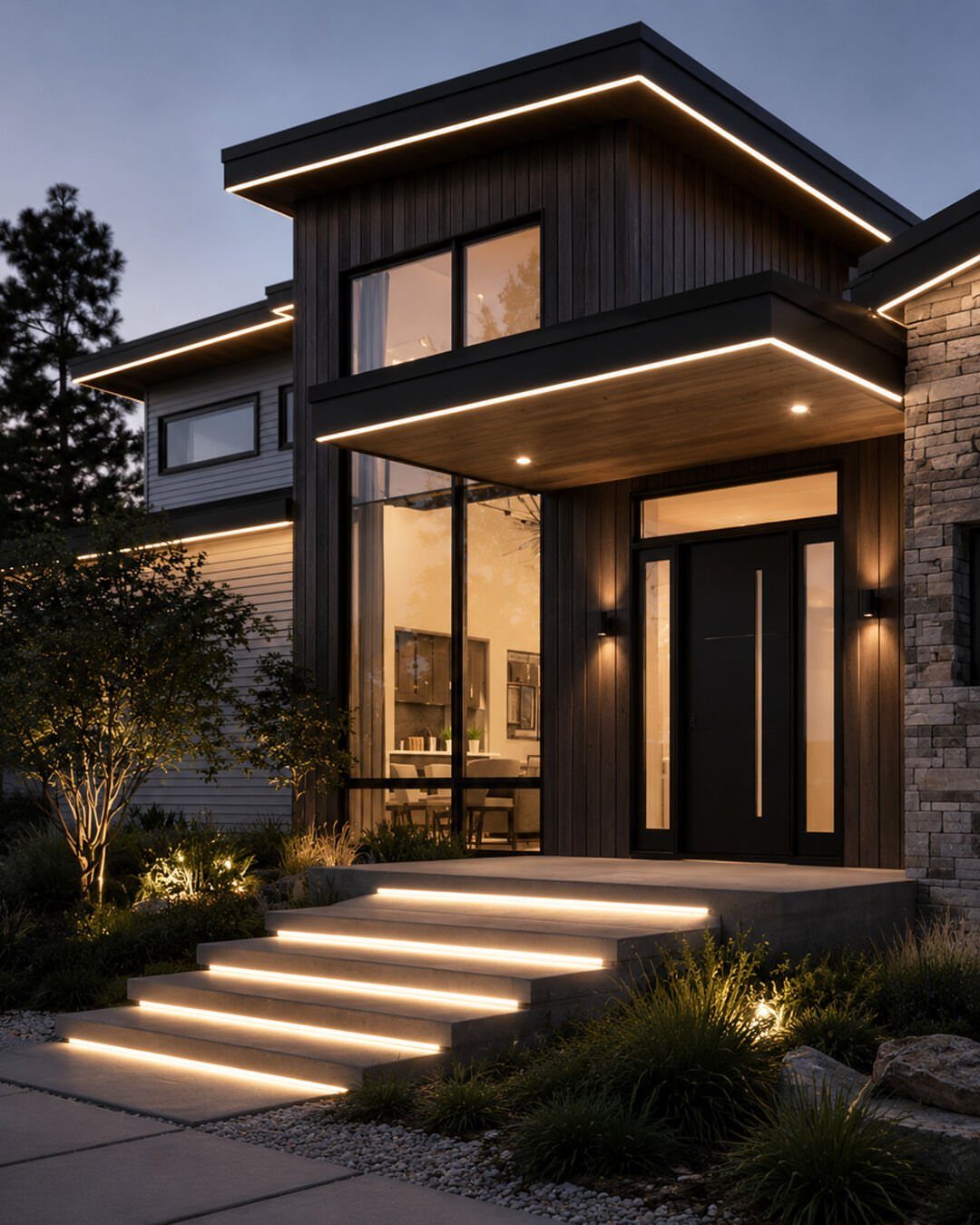
Under the roofline, rope light follows the house’s own geometry: the eaves, the porch ceiling and the stair edges all take the same line. A dark front door stands out well against that glow.
Plan the power connection near the porch before you mount anything, since a run this long needs a clean place to end. Keep the lines straight and parallel to the roof edge, because any wobble shows from the street.
9. Rope Lights on a Fence
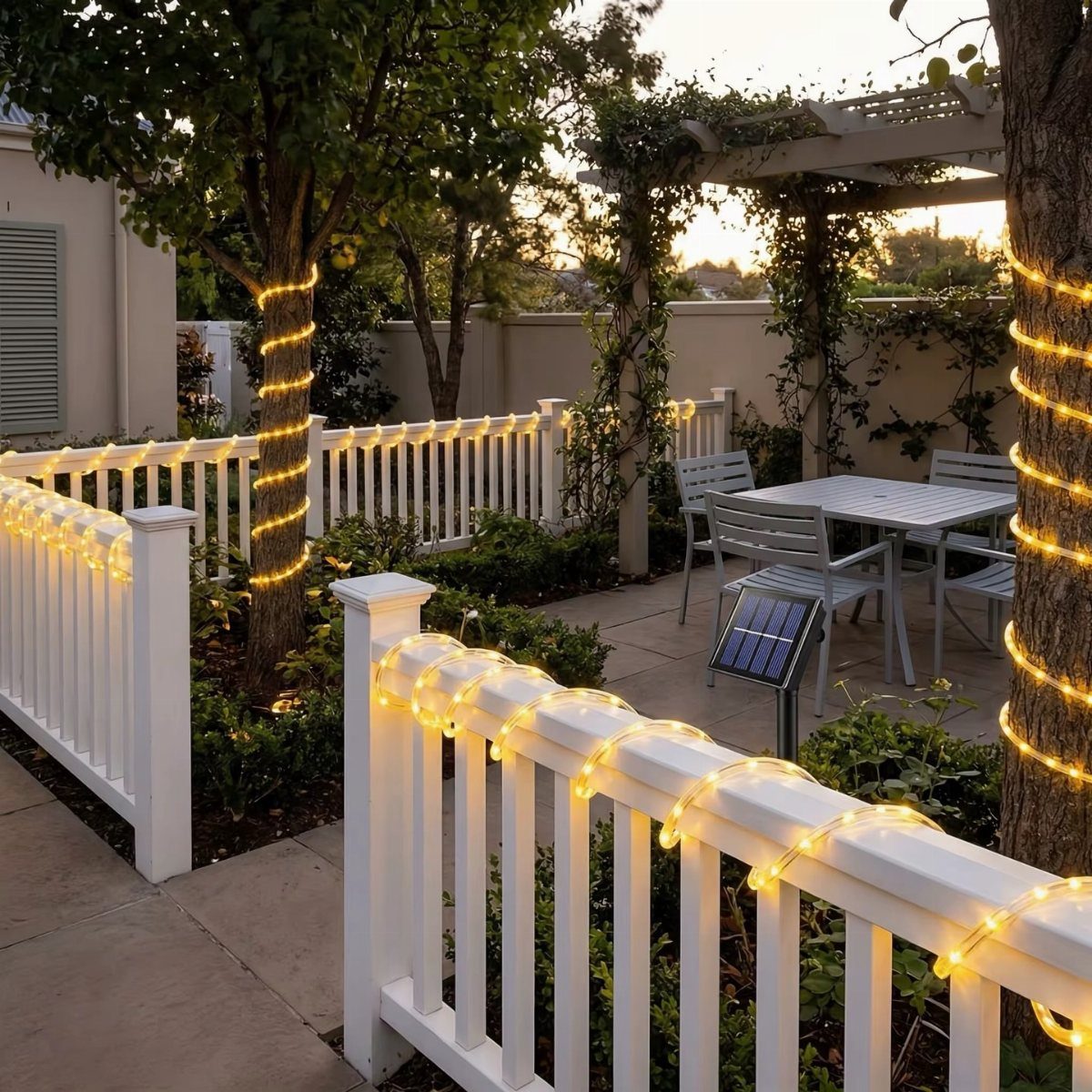
A white picket fence gives rope light a ready-made guide. Fix the line along one rail so it stays level, and match its warmth to any lit trunks nearby so the yard reads as a single scheme.
Fences often sit far from the nearest outlet, so decide how the power will reach the far end before you start. I’d keep to one run rather than layering several, and let the pergola area be the brighter spot.
10. Rope-Lit Walkway Edge
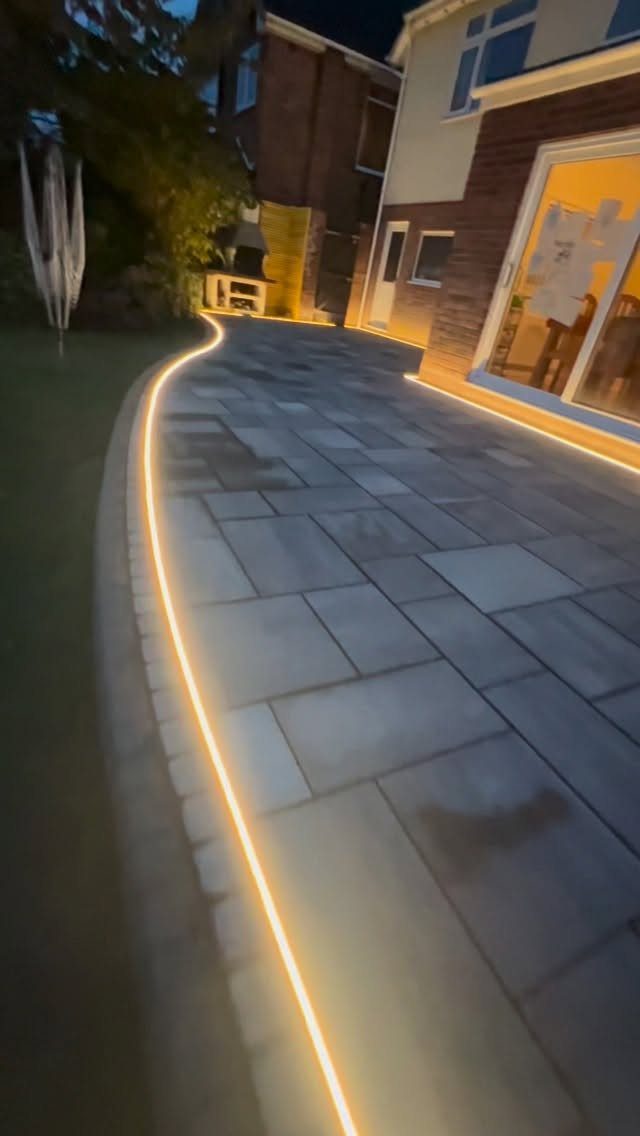
If the budget covers only one side of a walkway, pick the edge where stone meets lawn.
That boundary is the one people misjudge in the dark, and a single unbroken strip of warm yellow follows the curve like a drawn line.
Pointing the path toward a lit window gives the eye a destination at the far end.
11. Rope Lights on Steps
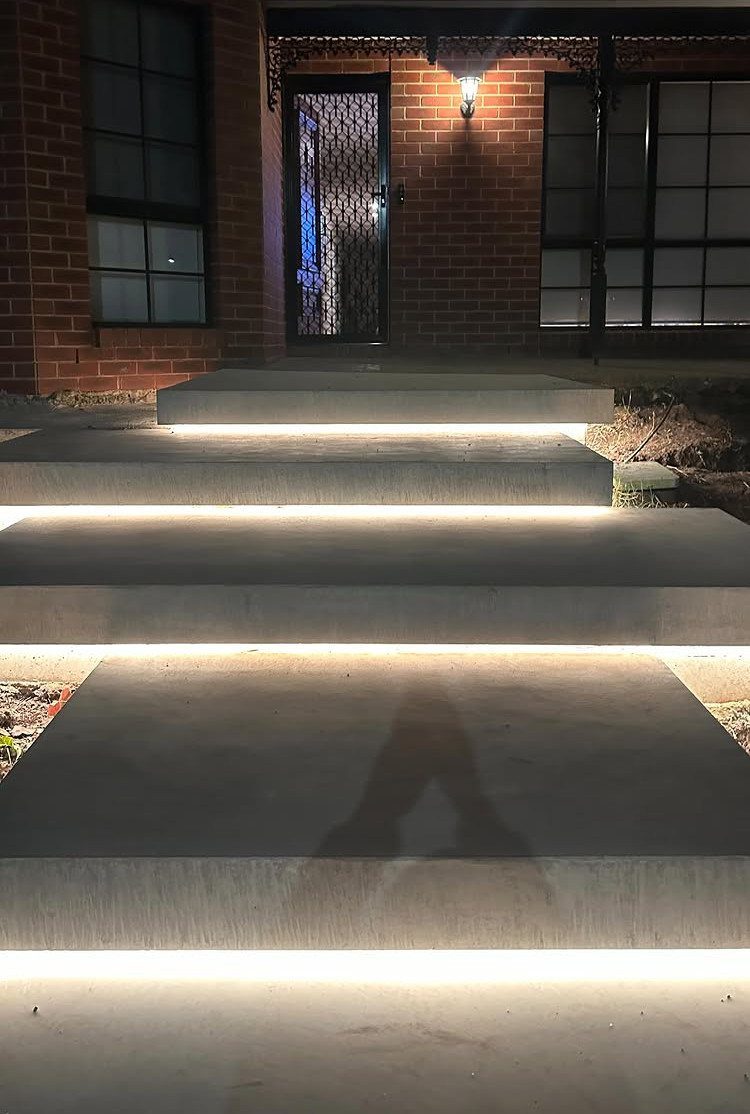
Concrete steps look cold after dark, and warm white rope light tucked under each ledge fixes that. Give every tread its own line so the stair reads as a set of bright, evenly spaced stripes.
Against brick, warm white looks softer than a pure white would. Keep the bulbs hidden under the lip; the glow should land on the step, not in anyone’s eyes.
12. Tree Wrapped in Rope Lights
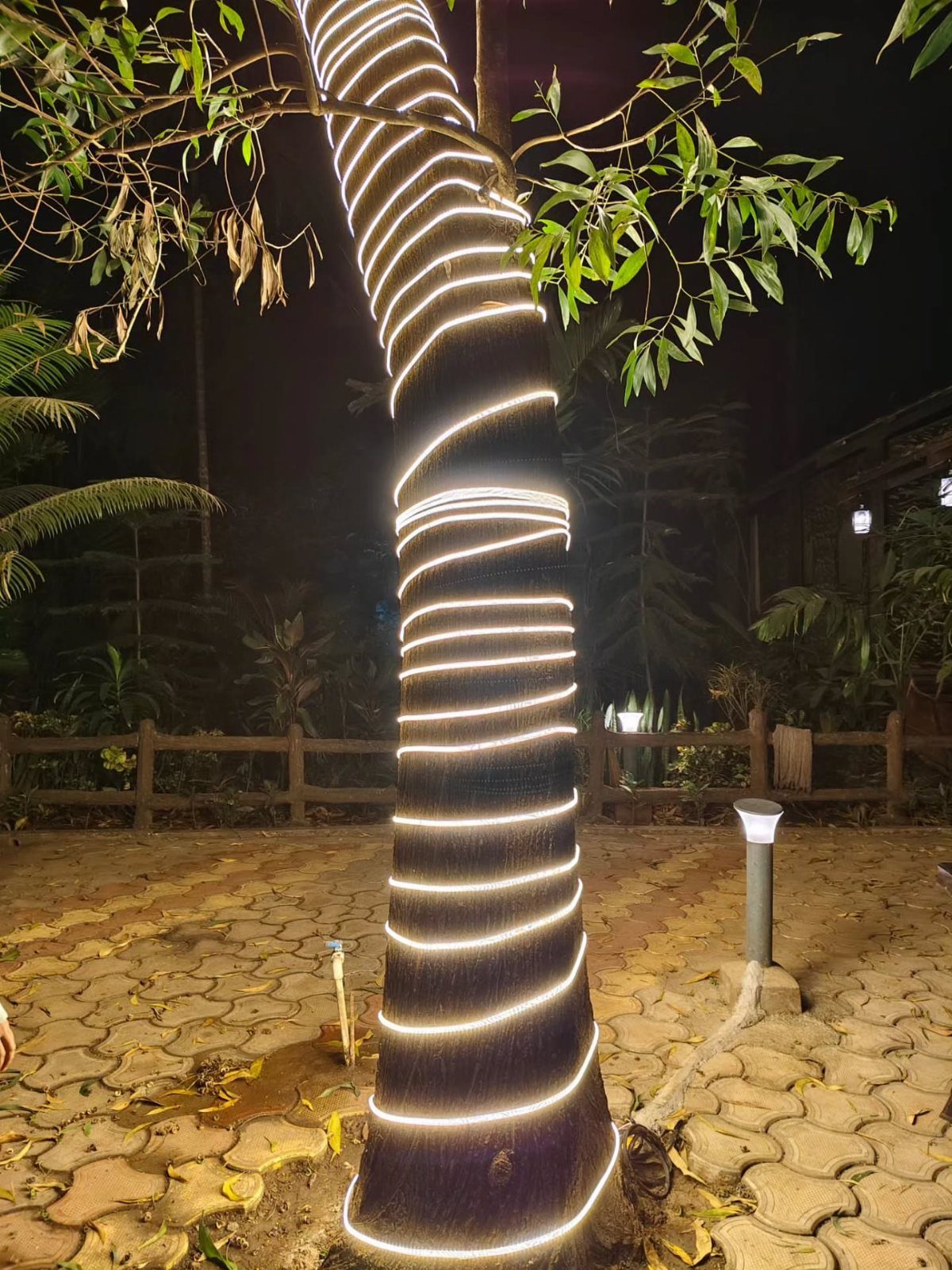
A palm has no branches to follow, so the trunk is the whole job: one spiral, base to crown, with evenly spaced turns. White rope light looks sharp against a wooden fence behind it.
I’d keep the pitch of the spiral consistent from bottom to top. Uneven turns are what make a wrapped trunk look improvised.
13. Rope-Light Garden Shapes
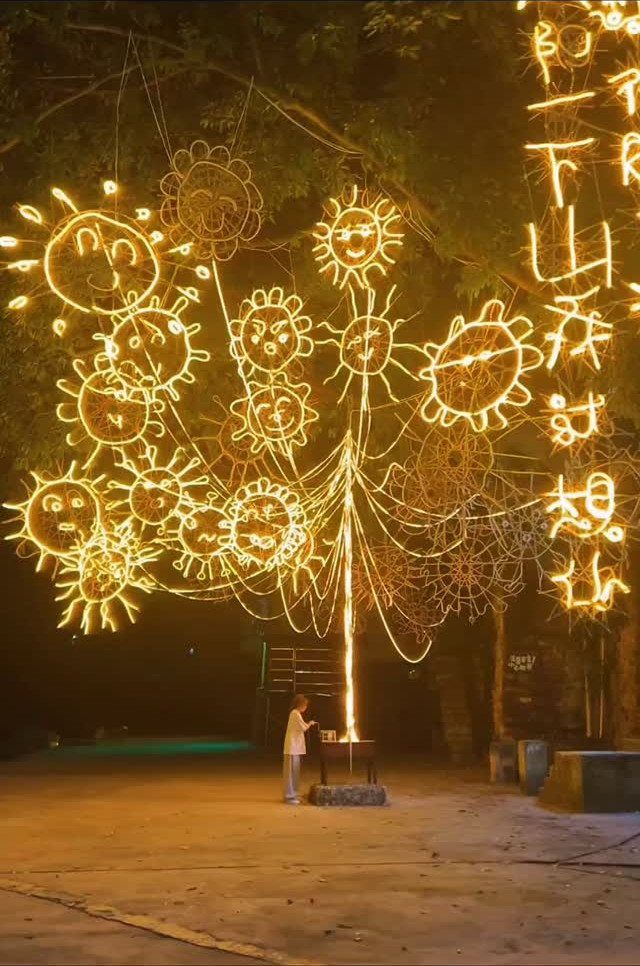
Rope light bent into outlines turns a bare tree into a glowing picture: round suns with small faces, flowers with simple petals. Yellow suits both, and keeping to one color lets the shapes carry the display.
Plan each shape on the ground before it goes up.
A circle with short rays reads as a sun, and a smile and 2 eyes finish the face. Stick to large, simple curves, because tight bends are where rope light kinks.
I’d hang a few shapes and leave the trunk dark between them.
Measure and Cut Safely
Measure the full run before you open the box, and keep the rope light on its spool until you know where it will sit.
Lay a tape or string along the route, add a little for the turns, and write the number down.
Cut only at the marked cut points, and only with the light unplugged.
Most LED rope lights have those marks every few feet, so check the product specs first. A cut anywhere between 2 marks can kill the section, and that stretch is usually not repairable.
If your measurement falls between 2 marks, go with the longer piece and tuck the extra into a straight, hidden spot rather than trimming at the wrong place.
Never plug in rope light while it is still wound on the spool. Unroll it fully first.
Match Connectors and Seal Ends
Voltage and wire count have to agree on both pieces before you join them, or the run won’t light properly.
Two spools that look the same on the shelf can be wired differently, so check the label on each one first, ideally with the original in hand, then add a second spool to the cart.
A connector also has to fit the rope’s diameter and the number of wires inside it, so a loose or mismatched plug is a sign you grabbed the wrong one.
A connector that is a little loose on the tubing will let moisture in and fail first.
Plan on a plug-in power connector feeding one end of each run and a sealed cap closing off the other.
Seal each connection so water stays out, because outdoor failures nearly always start at a joint rather than along the tubing.
I’d check each sealed joint again after the first rain.
Frequently Asked Questions
How long do rope lights last outside?
Quality LED rope lights are built to stay outdoors year-round, and they last many seasons with little loss of brightness or color.
The sealed tubing keeps moisture away from the LEDs and handles rain, snow and UV. Failures usually start at a joint, not along the tubing, so seal every connection and recheck it after the first rain.
What is the best exterior rope lighting?
A warm-toned rope light with marked cut points is the safest pick for most yards, because warm light flatters stone, foliage and wood.
Before you join spools, check that each one has the same voltage and the same number of wires, then pick connectors sized to the tubing’s diameter. A loose plug lets water in and fails first.
Are rope lights better than string lights?
It depends on the job. For borders, edging or any unbroken line, rope light is the better pick: the LEDs live inside a single flexible tube, so the glow looks smooth and even.
String lights hang separate bulbs along a cord, which makes them the better choice for a canopy overhead.
What are rope lights best used for outdoors?
They work best along edges: walkway borders, deck rails and deck perimeters, stair treads, eaves, fences and the foot of a low wall.
One unbroken line shows where an edge sits after dark, so people can see where a path turns or a step ends. They also wrap tree trunks and posts well.
What color rope light is best for outdoor pathways?
For most pathways, I’d go with warm white or warm yellow.
The amber tone feels inviting and sits naturally next to stone and plants. Cool white reads sharper and higher in contrast, a good match for modern landscaping, though it looks harsh fast against white-painted surfaces.
Can I cut LED rope lights to a custom length?
You can, as long as you cut only at the printed marks, which usually fall every few feet, and unplug the cord first.
Snipping between 2 marks usually kills that whole section, and the damage rarely can be fixed. When your measurement falls between marks, round up to the longer length and hide the leftover in a straight, out-of-sight stretch.