
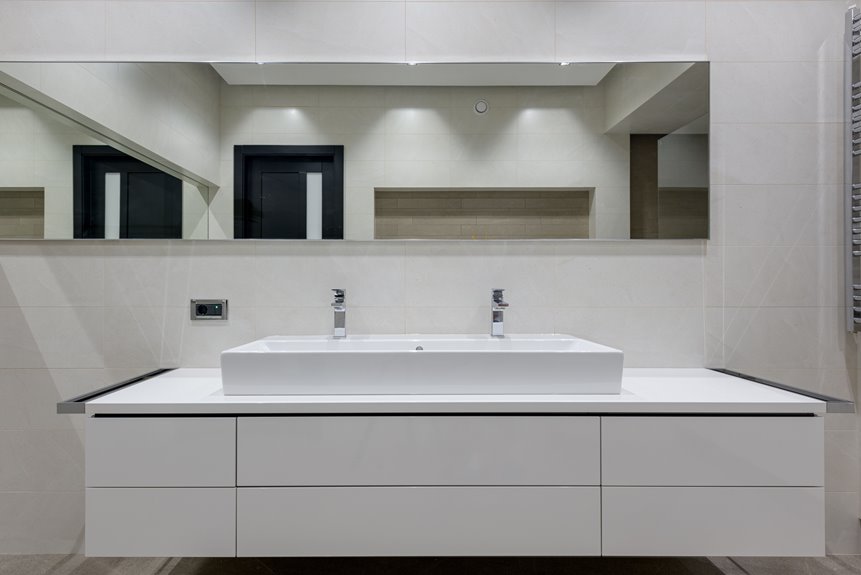
I’ve measured my own bathroom more times than I’ll admit, coffee in hand and tape measure in the other. The standard depth is 21 inches, which provides adequate plumbing clearance, functional sink space, and drawers with real storage capacity. Your specific needs matter more than any standard rule.
For a cramped powder room, consider slim 12-inch models from Kohler that save door swing space. If you have the square footage available, 24-plus inches creates a practical station for skincare bottles and hair tools.
Measure twice and consider your actual morning routine rather than idealized scenarios. This approach will help you determine the right depth for your space, and specific solutions exist for nearly every bathroom configuration.
Measure Your Bathroom for Vanity Depth Without Moving Plumbing
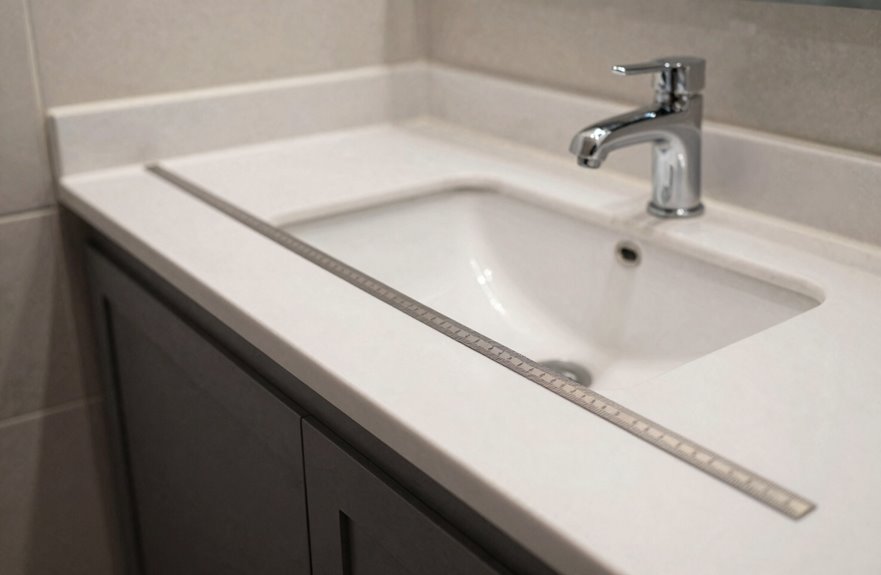
Where do you start when you want a deeper vanity but your plumbing is essentially fixed to the wall? Staring at an 18-inch existing cabinet depth can feel limiting.
First, grab your tape measure and get that wall-to-wall measurement. This is your hard limit. Check your drain location, supply lines, and that bulky P-trap because your vanity depth means nothing if you cannot reach the plumbing access.
Do not forget countertop depth. That gorgeous quartz adds inches, so your 21-inch cabinet becomes 22-plus in reality. A door clearance problem is worth avoiding. A towel bar catching the cabinet edge every morning creates daily frustration.
Measure twice to ensure accuracy.
Why 21 Inches Became the Standard Bathroom Vanity Depth
I’ve always wondered why 21 inches became the standard, and it’s not just an arbitrary figure. That depth gives your P-trap and supply lines, those pipes that often complicate DIY projects, sufficient space without forcing you uncomfortably close to the toilet. Additionally, it provides an ergonomic working height where you can lean over the sink to wash your face without adopting an awkward posture. My old apartment’s 18-inch vanity demonstrated this limitation quite effectively.
Plumbing Space Requirements
That 21-inch cabinet depth gives you just enough room behind the sink for everything: drain clearance for your pipes, supply lines snaking upward, and that chunky P-trap doing its anti-stink duty. Without proper rear clearance, you’re basically asking for a flooded bathroom.
Your countertop depth usually hits about 22 inches, which means everything aligns perfectly with standard plumbing layouts. Squeezing vanities into tighter spaces creates fixture spacing problems. The P-trap alone needs breathing room.
Some folks go deeper for extra storage, but that standard vanity depth is the sweet spot where practical plumbing meets comfortable knee clearance. It’s the practical choice for avoiding plumbing disasters.
Ergonomic Balance Points
Plumbing clearance is only half the story. The 21-inch standard depth emerged because it hits that sweet spot in bathroom design: practical and functional.
- User comfort matters significantly; you don’t feel like you’re doing yoga just to wash your face.
- Door swing and foot traffic remain unobstructed, preventing conflicts between the vanity and toilet paper holder.
- Countertop space and storage depth provide enough room for skincare products without creating an obstacle course.
Bathroom ergonomics directly impacts daily usability. The rear clearance behind the sink facilitates maintenance access. Deeper vanities may look impressive, but they require serious layout planning and reduce functional floor space. The 21-inch depth balances storage capacity with practical bathroom workflow and square footage efficiency.
12- to 16-Inch Depths: Slim Vanities for Tight Spaces
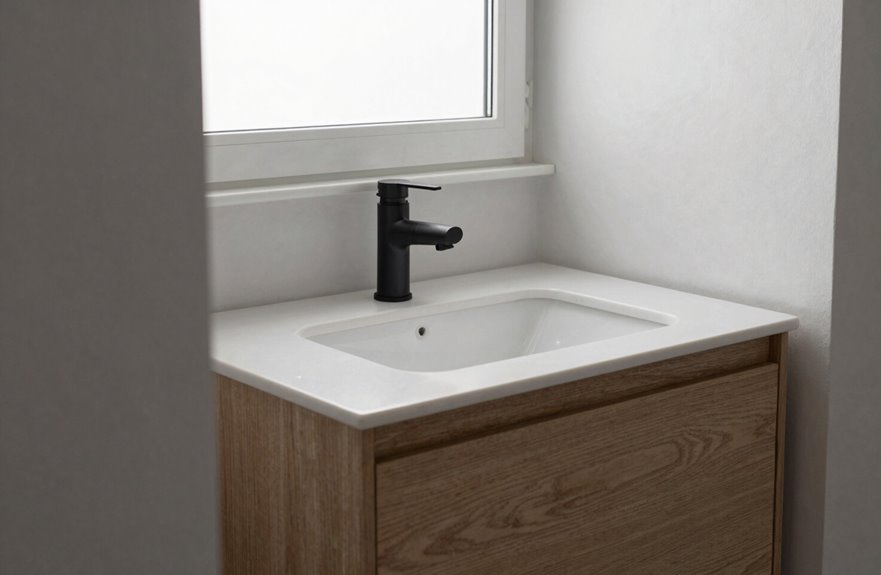
How do you squeeze a functional vanity into a space barely wider than a refrigerator? Shallow vanities are your best solution for tight bathrooms.
A slim vanity, think 12- to 16-inch vanity depth, transforms impossible tight spaces into actual usable bathrooms. I once wedged a 16-inch depth vanity into my aunt’s powder room, and she finally stopped storing toilet paper in the hallway closet.
In any compact bathroom, front clearance matters. You’ll want 21 inches minimum for walkways, and these shallow vanities deliver exactly that. Your bathroom layout functions better, doors swing freely, and nobody’s hip-checking fixtures at midnight.
Sure, storage capacity shrinks; expect smaller sinks, maybe integrated basins. But you gain livability. Match your slim vanity to truly tight spaces, and suddenly your cramped layout feels intentional, not accidental.
18- to 20-Inch Depths: The Versatile Middle Range
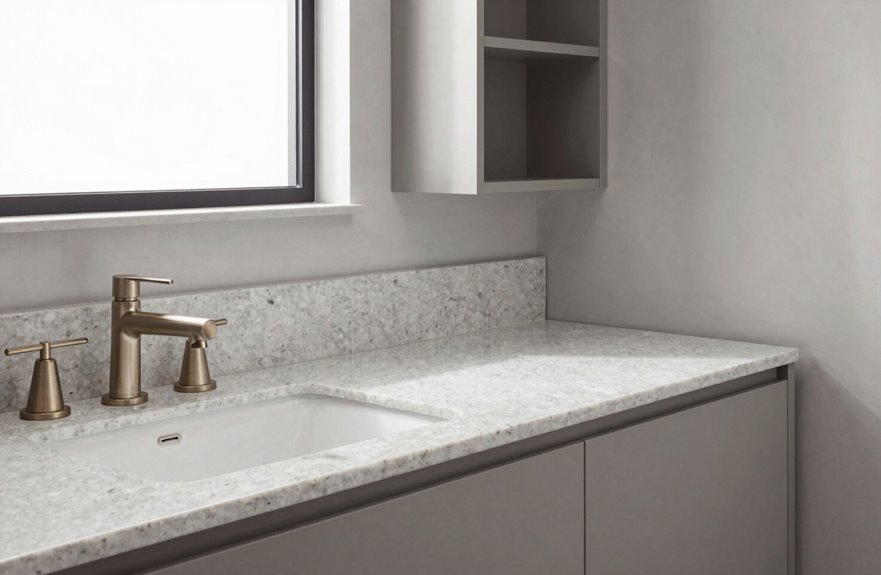
The 18- to 20-inch vanity depth offers a practical balance between storage and footprint. You get real drawer space for hair tools and backup toothpaste, not just a narrow sliver, while the footprint stays apartment-friendly so you’re not doing an awkward sideways shuffle to reach the toilet. Your countertop won’t feel like a landing strip, but you also won’t knock your elbows every time you floss. A 19-inch Kohler Poplin, for example, fits comfortably in standard bathrooms without dominating the space.
Balanced Spatial Fit
So where does that leave us if 12 inches feels cramped but standard depths swallow your whole bathroom? I’ve found my sweet spot in the 18-20 inch depth range, the mid-depth vanity option that delivers practical results.
This balanced spatial fit bridges the gap effectively. You’re not sacrificing everything for square footage, and you’re not tripping over your own bathroom layout either. I’ve seen this depth range work well in small-to-medium bathrooms everywhere, including my cousin’s Brooklyn apartment, which gained usable space after switching to this depth.
What makes this vanity depth effective:
- Space clearance that lets you actually move without doing the sideways shuffle
- Countertop space for your morning routine, coffee, skincare, and other essentials
- Drawer usability that doesn’t require yoga poses to reach your backup toothpaste
This is the practical middle ground that solves the competing demands of storage and mobility.
Storage Without Bulk
Why settle for choosing between a cramped powder room and a storage-starved sink when 18 to 20 inches hits that perfect stride? This mid-depth range feels like the Goldilocks zone of bathroom layout; it’s compact enough for tight spaces and generous enough for real storage.
In my own guest bathroom, basically a glorified closet, I chose an 18-20 inch vanity depth and finally gained drawers that actually hold full-size towels. The space efficiency delivers results. You get usable cabinetry depth without that bulky “looming furniture” effect.
Floor clearance stays comfortable, so you’re not doing awkward yoga poses just to reach the sink. For any compact bathroom, this vanity depth works; it’s practical, unpretentious, and fits the space perfectly.
21- to 24-Inch Depths: Standard and Roomier Options
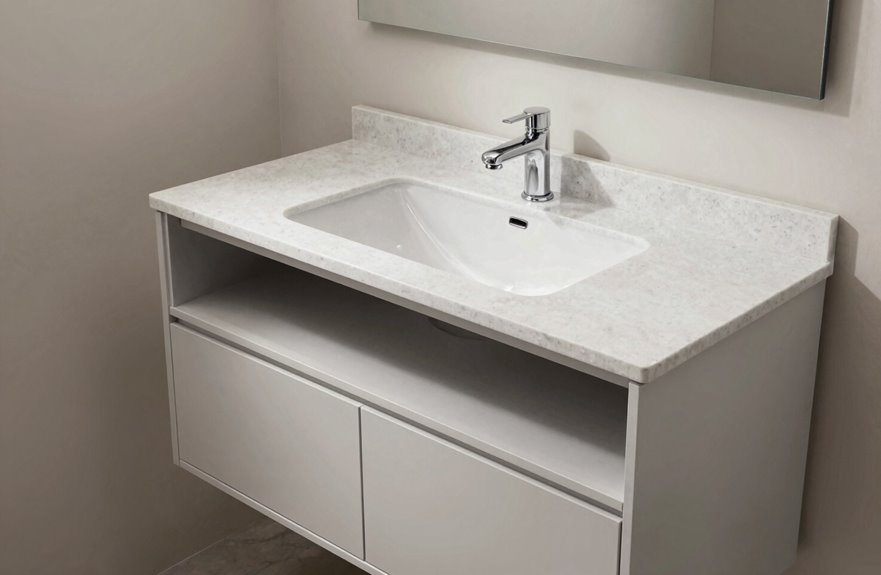
How exactly do you know when a vanity crosses from “perfectly practical” into “spa-worthy splurge territory”? It happens somewhere between 21 and 24 inches of vanity depth.
The 21-inch standard depth hits that sweet spot. It provides adequate plumbing clearance, decent storage, and a footprint that respects modest bathroom size. At 24 inches, the advantages become significant.
- Roomier vanities give you substantial countertop space for your skincare products
- That extra storage means finally hiding the hair dryer cords
- Deeper clearance lets you lean in comfortably without knocking elbows
Just watch your footprint in tighter spaces. Nobody wants a vanity that demands a contortionist routine. In roomy bathrooms, 24 inches pairs beautifully with oversized sinks and extended surfaces. You gain both functionality and practicality without compromise.
24-Inch-Plus Depths: When Extra Space Justifies the Footprint
Where exactly does a bathroom vanity stop being furniture and start being a statement piece. At 24-inch depth, you’re officially in “look at me” territory, and I mean that in the best way.
At 24-inch depth, a bathroom vanity stops being furniture and starts demanding the spotlight.
This vanity depth transforms spacious primary bathrooms into spa-like retreats. That extra storage provides genuine organizational benefits. The countertop space accommodates dual sinks without cramped positioning.
Clearance planning requires careful attention. Door swing clearance demands precise measurement, and plumbing placement requires accuracy. Faucet positioning affects daily usability. Wall-mounted floating vanities require substantial structural blocking; my contractor documented my initial underestimation of these requirements.
When executed properly, the result is a luxury bathroom. Deep-model layouts with enhanced surface area reflect intentional design investment. The footprint expansion delivers measurable functional returns.
Choose Your Depth Based on Storage Needs and Daily Use
Luxury depth is tempting, but most of us aren’t working with spa-sized footprints. In my galley bathroom, every inch of clearance space matters.
Your vanity depth should match your actual life, not some fantasy spa day. Consider these options:
- Shallow-depth vanities (12–16 inches) rescue tight bathroom layouts, though you’ll fight for storage needs like stashing extra TP rolls
- Mid-depth vanities (18–20 inches) hit that sweet spot. My friend Sarah’s apartment gem proves daily use doesn’t require sacrifice
- Standard depth (21 inches) with countertop overhang gives approximately 22 inches finished depth; enough for drawers, sink plumbing, and front-edge breathing room
Deeper options demand serious layout planning. I once coveted a 24-inch model until realizing my door swing would be blocked. Measure twice, store wisely.