
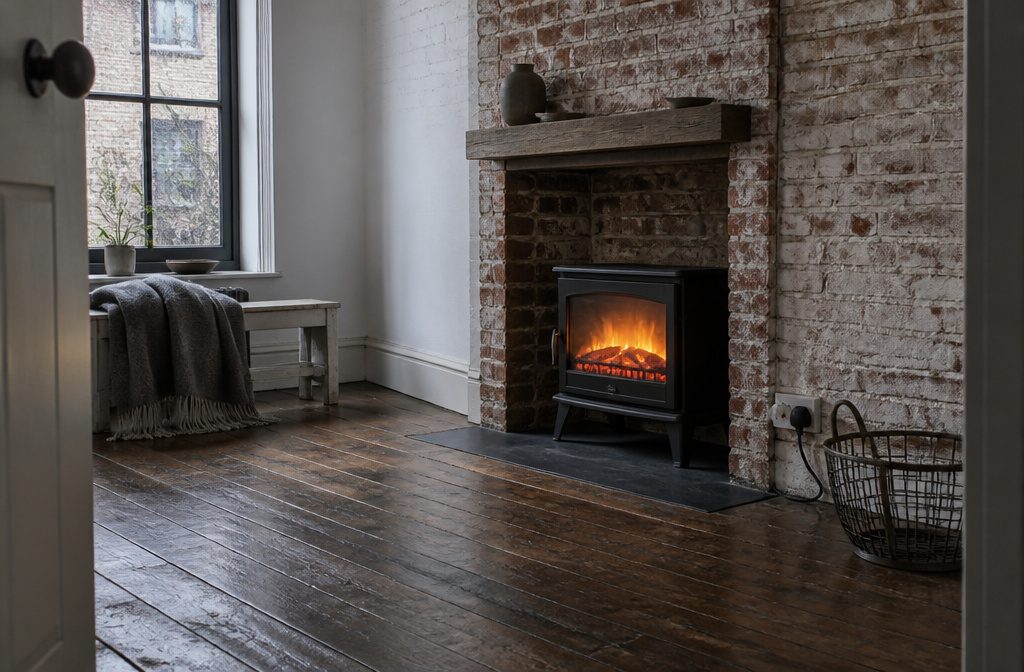
A home without a chimney can still have a fire in three ways: electric, which makes no exhaust; ventless gas or ethanol, which releases it into the room; or a piped system that sends it outside.
Ventless burners use up room oxygen and add moisture, so closed-up damp rooms rule them out. Tabletop ethanol models start at $418.
Electric Fires
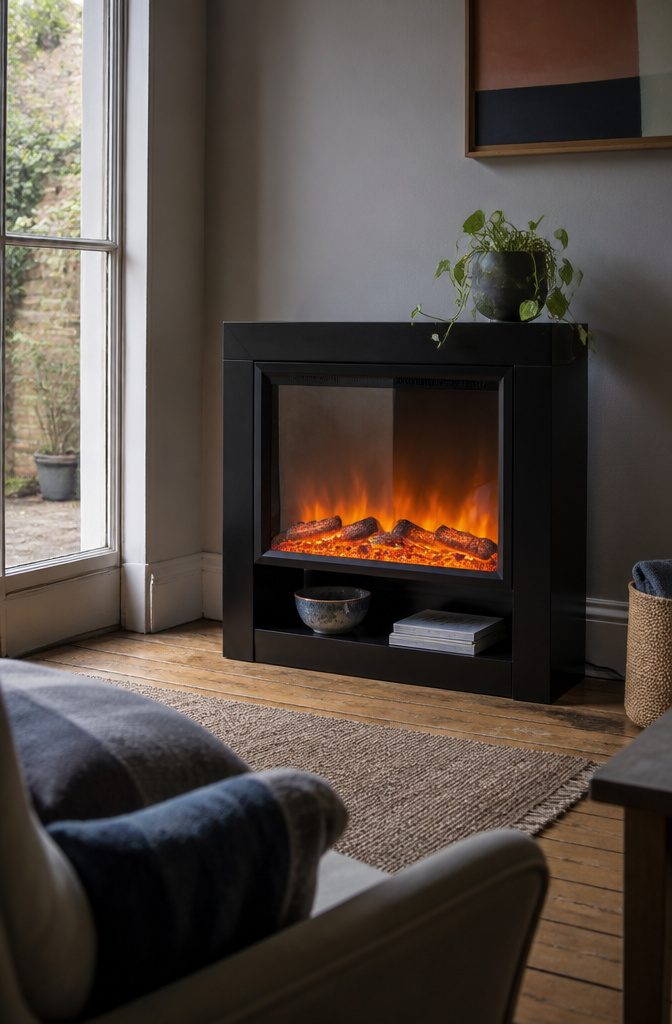
An electric fire produces no smoke and no gas, so nothing has to vent and no flue is needed.
For a home with no chimney, it’s the first option I’d look at. The range of realistic designs is huge now, and for many homes it’s a genuinely viable choice.
It suits renters best, along with anyone who has no gas supply or no wall they can open up. Nothing has to be cut, vented or tied into a gas line, so there’s very little to ask a landlord about.
An electric fire gives you no real flame, and it won’t crackle or smell like a wood fire either.
You won’t get the crackle or the woodsmoke smell. If a true flame is the whole reason you want a fireplace, an electric unit will disappoint you.
Ventless and Ethanol Fireplaces
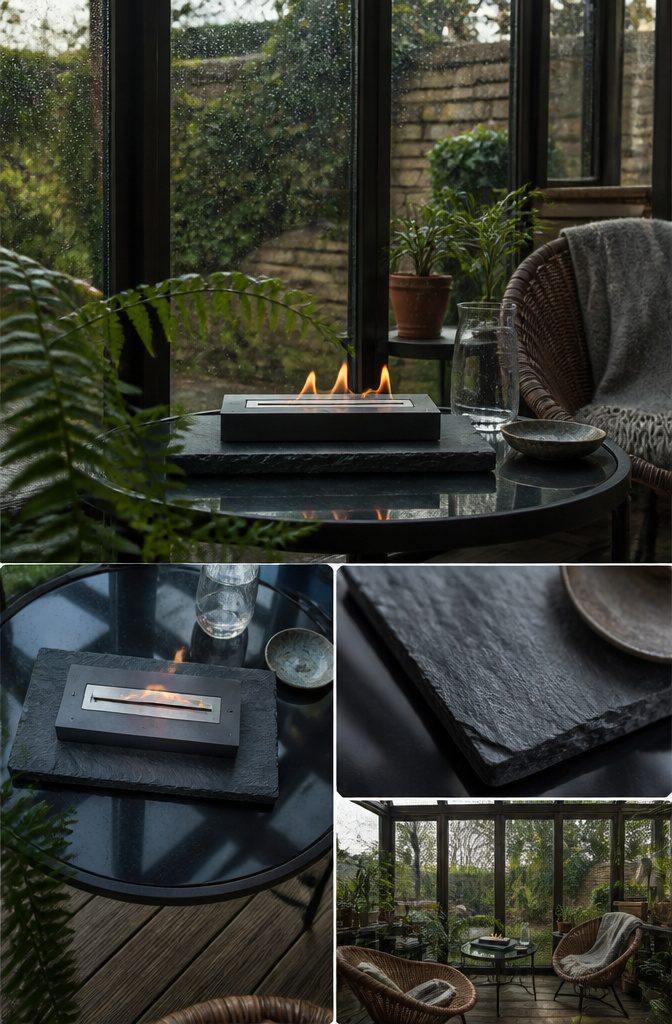
Flueless gas fires need no chimney, and some use a built-in catalytic converter, but a gas supply must reach the room. Ethanol units skip the gas line; makers claim no smoke, odor or ash and 40% better efficiency than wood.
Tabletop models win on price: the Wahrmann is $418 on a 10″ × 14″ slate base, the Ponton is $495 and burns 1.5 hours, and the Apollo is $825.
Bioflame’s Avante starts at $1,299, and the Blocco (27″ H × 48″ L × 36″ D) at $2,499. The Cocoon hanging set starts at $2,990 and burns up to 6 hours.
Ventless is the warmest option, but it burns room oxygen and adds water vapor, so I’d skip it in a closed-up, damp room.
Direct Vent Fireplaces

Two small pipes do the work in a direct vent fireplace: one pulls combustion air in from outside, the other sends exhaust back out.
The firebox sits behind a sealed glass front, so room air never feeds the flame and fumes stay outdoors.
For a real gas fire without a flue, this is the type I’d look at first. It needs an outside wall and a gas supply, so a fireplace planned for an interior wall is a much harder job.
Of the 269 products in one retailer’s catalog, 76 are direct vent.
Prices run high: only 28 listings fall at $1,000–$2,500, 88 sit at $2,500–$5,000, and 143 start at $5,000 and up. Those counts cover the whole catalog, not just direct vent, so use them as a rough guide.
Twin-Walled and B-Vent Flues
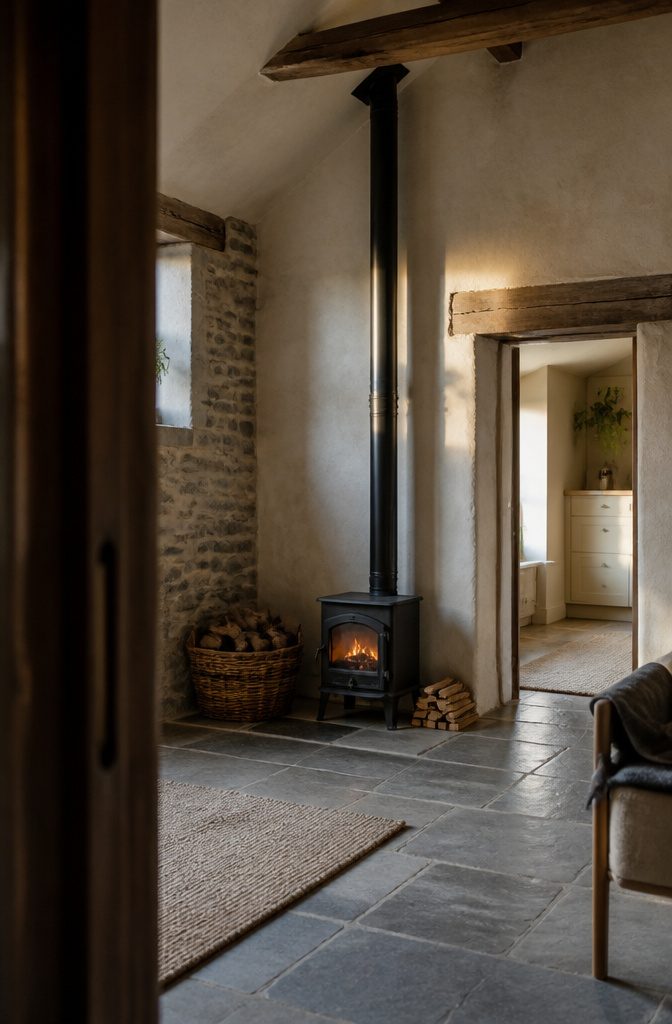
Both fires skip the masonry chimney by sending exhaust outside through a pipe. A twin-walled flue runs up an exterior wall or through the roof, and it’s the route I’d pick for a real wood-burning stove.
Plan around access to an external wall, because the system depends on it. If bare metal pipe bothers you, the flue can be boxed into a fake chimney stack outside.
B-vent units pull room air for combustion and send the exhaust out through their pipe. They’re relatively easy and inexpensive to install and cheap to run, and the flames come out large and realistic.
Heat is the cost: they put out less than a direct vent fire, so I’d treat one as a focal point rather than a heater.
Which Type Fits Your Home

Ventless gas is the warmest type, though it needs a gas supply in the room. Side by side, the options split mainly on install cost, heat output and whether they need any venting.
| Type | How it vents | Heat | Home must provide |
|---|---|---|---|
| Ventless gas | No flue; catalytic converter filters gases | Warmest | Gas line in the room |
| Twin-walled flue | Flue up an exterior wall or through the roof | n/a | External wall |
| Balanced flue | Through an exterior wall | Less than ventless | External wall and gas |
| B-vent | n/a | Less than direct vent | n/a |
| Electric | None | n/a | Nothing |
Renters should go electric, since nothing gets installed. With a gas line in the room, ventless wins on heat.
With wall access and gas, balanced flue works. Choose twin-walled only if you want a real wood-burning stove.
Safety and Care for Ventless Units

A chimney-free fire puts everything it makes into your room, so how you run it matters more than which model you pick.
- A ventless unit has no fresh air intake, so the fire borrows oxygen from the room it heats.
- Newer units carry sensors that monitor for low oxygen. I would skip any unit without one.
- With no vent, the fire releases a lot of water vapor. Watch windows and walls for dampness, since moisture invites mold.
- Carbon monoxide can end up in your living space, so keep a working detector in the same room.
- Where a flue is involved, debris, build-up or animal nests can block it. Regular inspection prevents that carbon monoxide risk.
- Stay attentive while it burns. A careful operator makes this an inexpensive, safe option.
Frequently Asked Questions
Can I have a fireplace without a chimney, and what types work?
Yes. Electric fires, ventless gas fires, ethanol units, direct vent gas fireplaces, B-vent units and twin-walled flue systems all work without a masonry chimney.
Electric is the simplest because nothing vents and no gas line is involved. Ventless gas needs a gas supply in the room, while direct vent and twin-walled setups need an exterior wall.
What are the disadvantages of a ventless gas fireplace?
A ventless gas fireplace draws oxygen from the room it heats, adds water vapor to the air, and can release carbon monoxide into your living space. The extra moisture can lead to damp windows and walls, and then mold.
Buy a unit with a low-oxygen sensor and keep a working carbon monoxide detector in the same room. It also needs a gas line running to that room.
How can I vent my gas fireplace to the outside?
A direct vent fireplace is the usual answer: two small pipes run through an exterior wall, one bringing combustion air in and the other sending exhaust out, with a sealed glass front keeping room air out of the flame.
It needs an outside wall and a gas supply, so an interior-wall location is a much harder job. A B-vent unit also sends exhaust out through its own pipe, but it burns room air and gives off less heat.